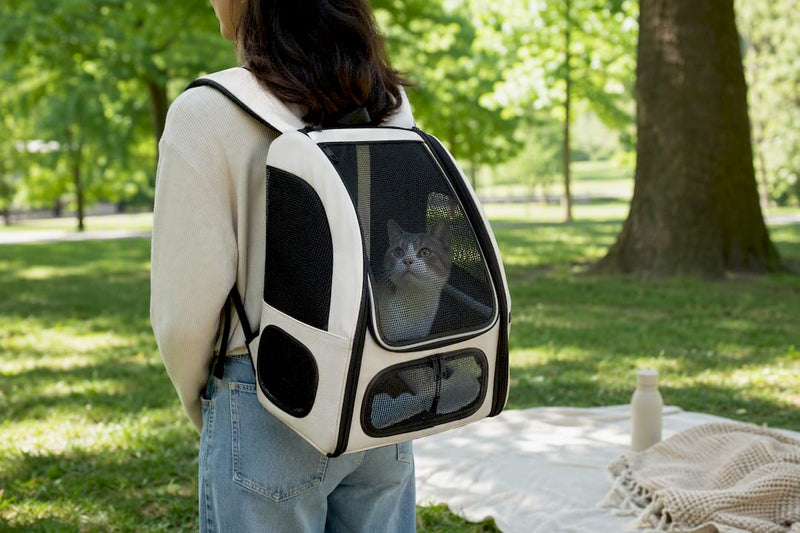
Most major U.S. airlines accept soft-sided in-cabin carriers up to sizes commonly reported around 18 x 11 x 11 inches (length x width x height). That number comes from American Airlines, Delta, and United, though each carrier sets its own limit and can enforce it differently at the gate. A few airlines publish different maximums:
- American, Delta, United: approximate soft-sided size limits near 18 x 11 x 11 inches
- Southwest: somewhat larger allowed footprint
- JetBlue: slightly smaller height limits
Before you buy anything, open your airline’s official pet policy page and reserve a pet spot. Most flights cap in-cabin pets at four to six total, and spots fill up fast.
Key Takeaways
Most U.S. airlines accept soft-sided in-cabin carriers up to sizes generally around 18 x 11 x 11 inches, but the exact limit depends on the specifications published by your airline for your specific aircraft.
| Point | Details |
|---|---|
| Common U.S. cabin limit | Most major airlines publish 18 x 11 x 11 inches for soft-sided carriers; Southwest and JetBlue differ. |
| Measure cat before carrier | Use IATA formulas: internal length = body length plus half leg length; height = ear height plus bedding. |
| Soft-sided is preferred | Soft carriers compress to fit under seats, but ventilation must stay open on at least three sides. |
| Reserve a pet spot early | Most flights cap in-cabin pets at four to six; spots are first-come, first-served. |
| Verify aircraft type | Regional jets and code-share legs may have no under-seat space, even with a compliant carrier. |
| The Meow Picks | Carriers in the catalog list external dimensions on their product pages for direct comparison against airline limits. |
Table of Contents
- What “airline-approved” actually means for cat carriers
- How to measure your carrier and your cat
- Typical maximum carrier sizes for major U.S. airlines
- How strict airlines are about carrier size at the gate
- Options if your carrier or cat is too large for cabin travel
- Buying checklist: what to look for in an airline-compliant carrier
- The Meow Picks carrier recommendations
- Pre-flight checklist for the 24–72 hours before departure
- International airlines and regional carriers: how size limits differ
- How airline cat carrier size rules have been shifting
- What to look for on carrier labels and product listings
- The Meow Picks’ perspective on choosing a travel carrier
- Carriers curated for travelers at The Meow Picks
- Sources
- FAQ
What “airline-approved” actually means for cat carriers
The phrase “airline-approved” is marketing language, not a government certification. No federal agency issues a stamp of approval for pet carriers. What matters is whether your specific carrier fits under the seat in front of you on your specific aircraft, and whether it meets your airline’s published construction requirements.
The closest thing to an industry standard comes from IATA’s Live Animals Regulations, which set minimum internal dimensions, ventilation requirements, and construction rules for containers used in air transport. IATA guidance applies most strictly to cargo, but airlines reference it for cabin travel too.
Individual airlines then layer their own under-seat dimension limits on top of that baseline. Those limits are often stricter than IATA’s minimum, because they are constrained by the physical space under a specific aircraft seat. The U.S. Department of Transportation publishes consumer guidance on traveling with animals, but it does not set carrier dimensions. That authority stays with each airline.
Key construction requirements most airlines share:
- Soft-sided and collapsible (preferred for cabin; hard-sided limits vary by aircraft)
- Ventilation on at least three sides
- Leakproof base or liner
- Secure, escape-proof zippers or closures
- No wheels or rigid protrusions that prevent under-seat stowage
Because “airline-approved” is not an official certification, always confirm carrier acceptance directly with your airline and for the specific aircraft type on your itinerary.
How to measure your carrier and your cat
Getting the dimensions right requires two separate measurements: the carrier’s external footprint and your cat’s body. Both matter.
Measuring the carrier:
- Measure external length, width, and height with the carrier fully assembled and zipped. Use a rigid tape measure, not a soft one.
- For soft-sided carriers, compress the sides gently by hand to simulate under-seat pressure, then re-measure height. This is the compressed height your airline will care about.
- Check that ventilation mesh covers at least three sides and that the openings are not blocked when the carrier is compressed.
- Weigh the carrier empty, then again with your cat inside, to confirm you stay within the airline’s combined pet-plus-carrier weight limit (often 20 lbs total).
Measuring your cat:
- Body length: measure from the tip of the nose to the base of the tail.
- Standing ear height: measure from the floor to the top of the ears while the cat stands naturally.
- Shoulder width: measure across the widest point of the shoulders.
IATA-aligned formulas convert those measurements into minimum internal carrier dimensions: internal length = body length plus half the leg length; internal width = two times shoulder width; internal height = standing ear height plus bedding thickness. IATA and travel calculators also recommend at least 2–3 inches of clearance between the top of your cat’s ears and the carrier roof. Snub-nosed breeds (Persians, Himalayans) need roughly 10% more internal space to breathe comfortably.
Pro Tip: Place your cat inside the carrier with the door zipped and slide it under a chair or table that matches typical under-seat height (roughly 9–11 inches on most narrowbody jets). If the carrier compresses too much and the mesh collapses against your cat’s face, the carrier is too tall for that aircraft.
The Nooee Jackson Travel Mat is worth considering as a thin, compressible liner that adds minimal height while still giving your cat a familiar surface.
Typical maximum carrier sizes for major U.S. airlines
The table below reflects published or widely reported soft-sided in-cabin maximums. Hard-sided limits vary by aircraft and are generally smaller. Always verify on the airline’s official pet policy page before travel.
A few things worth noting across these airlines:
- Regional jets operated under code-share agreements (like Envoy for American or SkyWest for United) often have no under-seat space at all, which means your cat may be denied cabin travel on that leg.
- Southwest and Spirit allow a wider footprint but impose a lower height, which rewards flatter carriers.
- JetBlue’s 8.5-inch height limit is one of the most restrictive among major carriers, so double-check before booking.
Pro Tip: When you book, note the aircraft type (Boeing 737, Airbus A320, etc.) and search “[airline] + [aircraft type] + under-seat dimensions” to find traveler-reported measurements for that specific seat row.
How strict airlines are about carrier size at the gate
Enforcement varies, and that variability is part of what makes this stressful. Gate agents have discretion, and some will wave through a carrier that is slightly over; others will measure it on the spot. The safest assumption is that your carrier will be checked.
Common triggers for rejection at the gate:
- Carrier visibly bulges or does not compress to fit under the seat
- Ventilation mesh is blocked or insufficient
- The flight has already reached its pet limit (usually four to six pets per cabin)
- The aircraft type changed after booking and the new plane has less under-seat space
- The cat cannot be fully zipped inside the carrier
If your carrier is rejected, the gate agent may offer to check it as baggage or route it as cargo. Neither option is ideal for a cat, and cargo placement on short notice is not guaranteed. United’s pet policy explicitly notes that under-seat space varies by aircraft, which is the airline’s way of saying the same carrier may be fine on one flight and refused on another.
Pro Tip: Print or screenshot the carrier’s external dimensions and your airline’s published pet policy. If a gate agent questions the size, you can show the specs immediately rather than arguing from memory. Agents are more likely to accept a carrier when the owner can demonstrate it meets the published limit.
What to carry in your bag to handle a gate dispute: the carrier’s product page or packaging showing external dimensions, your pet reservation confirmation, and the airline’s pet policy screenshot.
Options if your carrier or cat is too large for cabin travel
A cat that cannot stand, turn around, and lie down inside the carrier cannot legally travel in cabin under IATA guidance. If your cat is simply too large for any compliant cabin carrier, you have a few realistic paths:
- Buy a compliant carrier sized for your cat. Measure your cat first using the IATA formulas above, then shop for a carrier whose internal dimensions meet those minimums and whose external dimensions fit your airline’s limit. For larger cats, this can be a narrow window. The cat furniture for large cats guide on The Meow Picks covers sizing principles that apply to carriers too.
- Book cargo transport. Airlines that accept pets in cargo require IATA-compliant hard-sided crates with specific ventilation, locking mechanisms, and labeling. Contact the airline’s cargo division directly, not the passenger desk, and confirm fees, temperature restrictions, and embargo dates (many airlines suspend pet cargo in extreme heat or cold).
- Defer or restructure the trip. If cargo travel is not safe for your cat’s breed or health, postponing is a legitimate choice. Snub-nosed breeds face elevated respiratory risk in cargo holds.
- Drive or use ground transport. For trips under 8–10 hours, a car trip with a larger crate is often safer and less stressful than forcing a large cat into a too-small cabin carrier.
IATA and veterinary guidance both emphasize that a carrier that is too small is a welfare issue, not just a policy one. A cramped carrier raises stress and body temperature, particularly on longer flights.
Buying checklist: what to look for in an airline-compliant carrier
The difference between a carrier that sails through the gate and one that gets pulled is usually in the details of how it was built and whether the seller published the right specs.
Before purchasing, confirm each of these:
- External dimensions are listed explicitly (length x width x height), not just “fits most airlines”
- Soft-sided and compressible, with enough structural integrity to maintain ventilation when compressed
- Ventilation on at least three sides, with mesh that stays open under light pressure
- Leakproof base or a removable, washable liner
- Escape-proof closures: double-zipper or locking zipper tabs
- No rigid wheels or protrusions that prevent under-seat stowage
- Weight listed so you can calculate pet-plus-carrier total
The distinction between internal and external dimensions trips up a lot of buyers. Airlines measure the external footprint for stowage. IATA formulas measure the internal clearance for the cat’s comfort. A carrier that passes the external test can still fail the comfort test if the walls are thick or the base liner is bulky. Prefer models that publish both.
Soft-sided carriers can compress to fit varied under-seat spaces, but over-compression reduces ventilation and can create heat buildup. A carrier with rigid mesh panels on the sides holds its shape better than one with pure fabric walls.
Pro Tip: Look for carriers that specify which aircraft seat types they fit (for example, “fits under most narrowbody seats”) rather than generic “airline-approved” labels. That specificity signals the manufacturer actually tested the footprint.
The Petkit Breezy 2 Cat Carrier and the Porto Cat Carrier at The Meow Picks both list external dimensions on their product pages, which is the minimum you should expect from any carrier you consider for air travel.
The Meow Picks carrier recommendations
The Meow Picks curates carriers that publish their external dimensions and are built with the ventilation and closure standards airlines expect. Three featured picks worth checking:
-
Apawtment Cat House: A structured soft-sided design with mesh ventilation panels. Check the product page for current external dimensions and confirm they fall within your airline’s published limit before booking.
-
Torre Cat Tower: Designed with a compact footprint and secure closures. Verify the listed dimensions against your specific airline’s maximum, particularly if you are flying JetBlue or Alaska, which have tighter height limits.
-
Perla Cat Cave: A softer, more flexible option that compresses well. Confirm the external height when compressed, since soft designs can vary depending on how much bedding you add inside.
Additional carriers with published dimensions available at The Meow Picks:
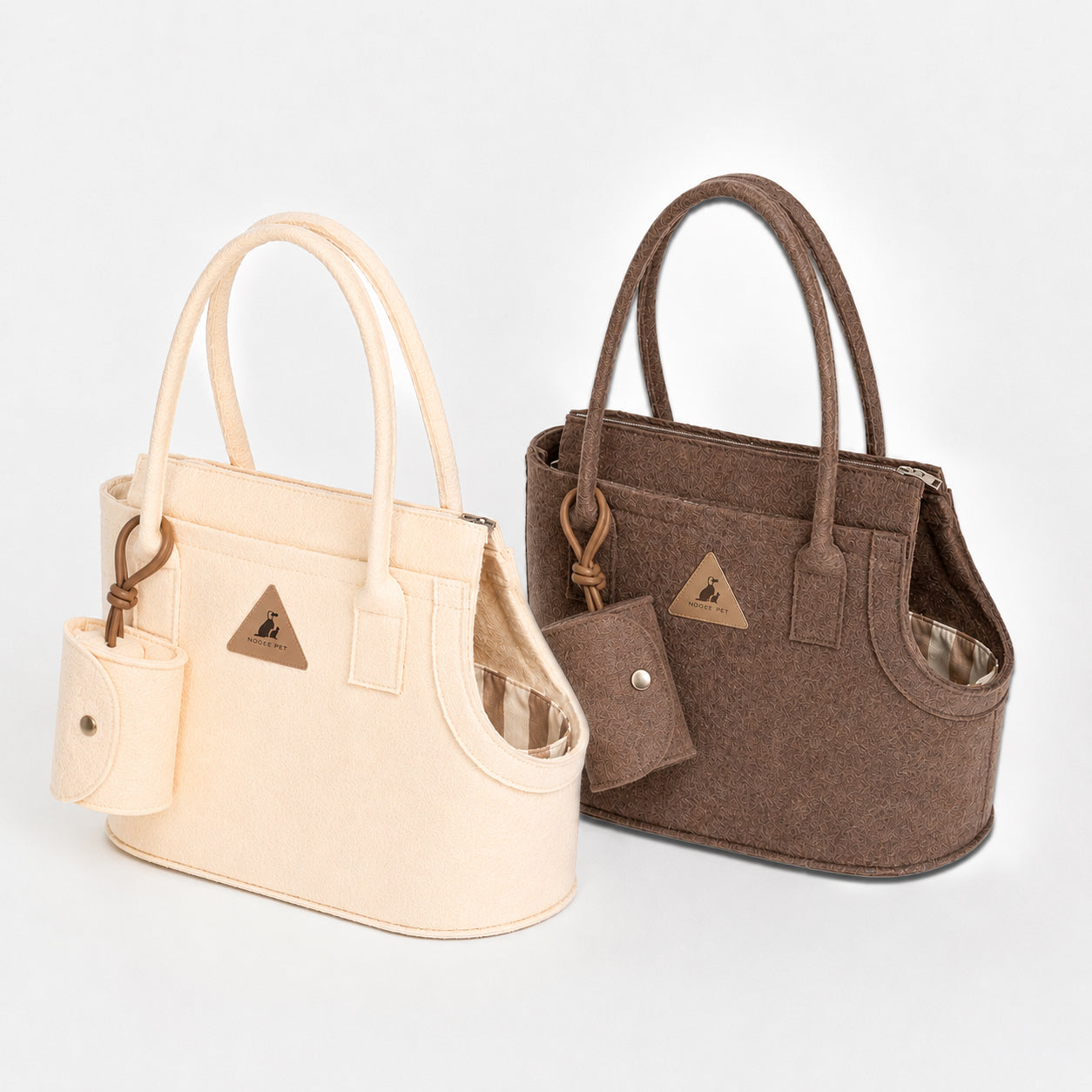
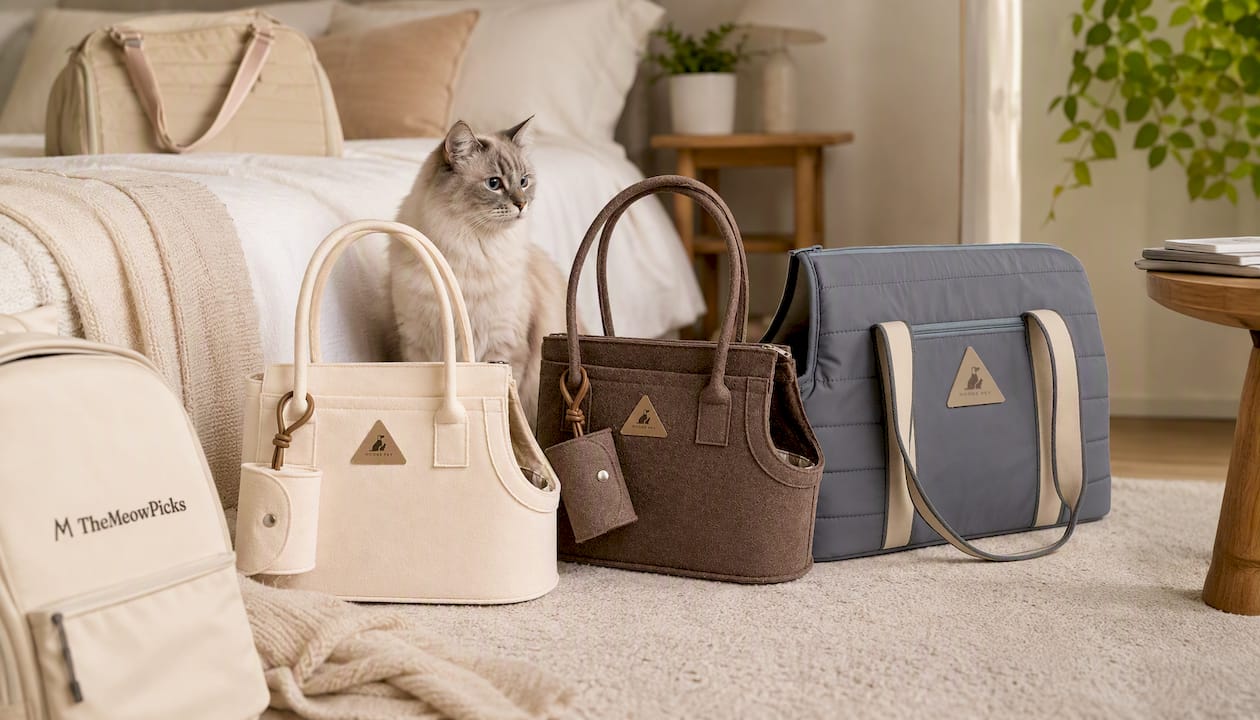
- Nooee Ash Cat Carrier: listed external dimensions, felt construction with ventilation openings
- Nooee Oliver Cat Carrier: quilted soft-sided design with published specs
- Nooee Finn Cat Carrier: lightweight quilted construction with easy-care cushion
Airline acceptance is not guaranteed for any carrier. Acceptance depends on the specific aircraft, the gate agent’s judgment, and whether the pet spot reservation is confirmed. Always verify dimensions on the product page and cross-check against your airline’s current pet policy before travel.
Pre-flight checklist for the 24–72 hours before departure
Work through these steps in order to reduce the chance of a gate surprise.
- Confirm your pet spot reservation with the airline (phone or online, depending on the carrier). Get a confirmation number.
- Pull up the airline’s current pet policy page and screenshot the exact dimension limits for your flight’s aircraft type.
- Measure the carrier one more time with your cat inside and the door zipped. Confirm external dimensions match what you recorded when you bought it.
- Weigh pet plus carrier together on a bathroom scale. Confirm the total is under the airline’s combined weight limit.
- Pack the carrier’s product page (printed or saved offline) showing external dimensions, alongside your pet reservation confirmation.
- Acclimate your cat to the zipped carrier for at least two sessions before travel day. A cat that panics inside a zipped carrier is harder to stow safely.
- Arrive at the airport early (at least 30 minutes before your normal buffer) to allow time for any carrier inspection at check-in.
- At the gate, confirm the aircraft type has not changed since booking. If it has, ask the gate agent immediately whether cabin pets are still permitted on the new aircraft.
- Do not feed your cat for 4–6 hours before the flight to reduce the risk of motion sickness and accidents inside the carrier.
- Keep the carrier under the seat in front of you for the entire flight. Placing it in the overhead bin is not permitted.
International airlines and regional carriers: how size limits differ
International airlines generally follow IATA Live Animals Regulations more closely than U.S. domestic carriers, but their under-seat dimension limits still vary by aircraft and route. A few patterns worth knowing:
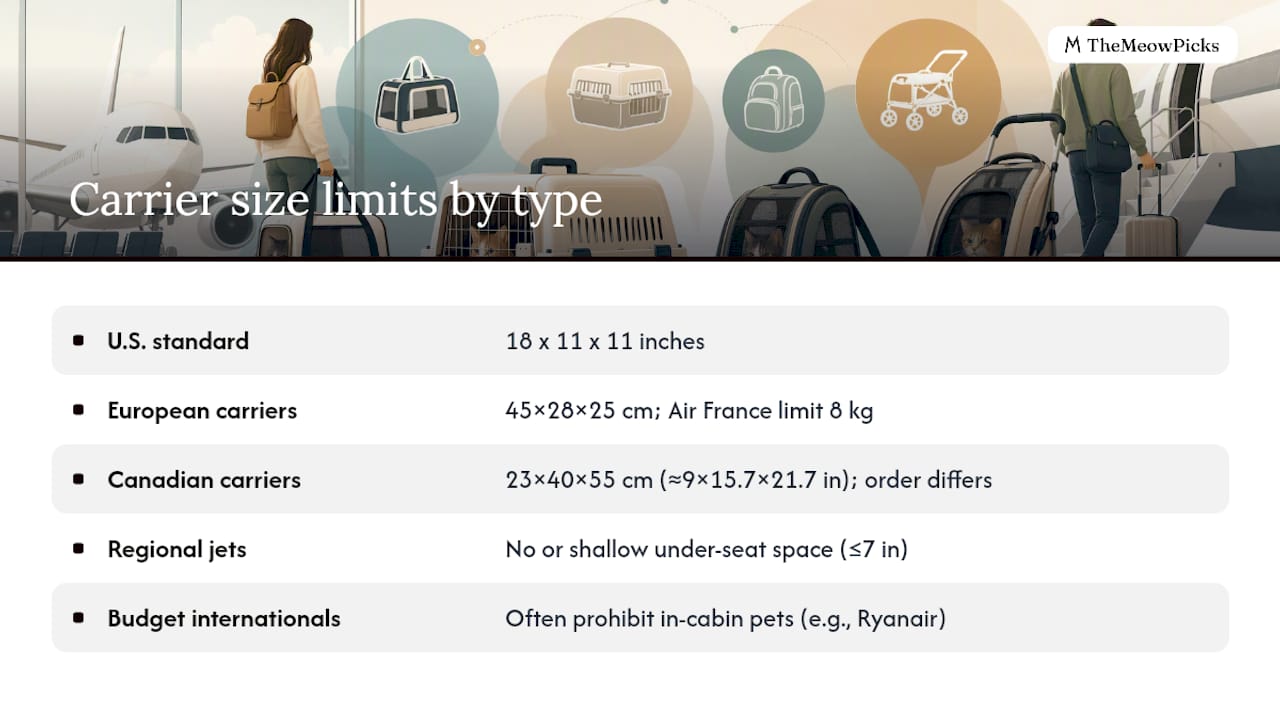
European carriers such as Lufthansa, Air France, and KLM typically publish maximum carrier dimensions in the range of 45 x 28 x 25 cm (roughly 17.7 x 11 x 9.8 inches), which is slightly smaller than the U.S. standard of 18 x 11 x 11 inches. Air France lists a combined pet-plus-carrier weight limit of 8 kg (about 17.6 lbs).
Canadian carriers like Air Canada publish limits close to U.S. norms (typically 23 x 40 x 55 cm, or about 9 x 15.7 x 21.7 inches), but the order of dimensions differs from U.S. convention, so read carefully.
Regional jets operated under code-share agreements are the most unpredictable category. A 50-seat Embraer ERJ-145 or a Bombardier CRJ-200 may have no under-seat space at all, or a space so shallow (sometimes under 7 inches) that no standard cabin carrier fits. On these aircraft, the airline may require your cat to travel as checked baggage or deny the pet entirely. Always call the airline when your itinerary includes a regional connection.
Budget international carriers often do not allow pets in cabin at all on transatlantic or transpacific routes. Ryanair, for example, does not permit pets in the cabin on any flight. Confirm pet policy before booking any international itinerary.
How airline cat carrier size rules have been shifting
The most significant recent trend is stricter enforcement, not looser rules. Several factors are driving this:
Airlines have been updating their pet policies more frequently since 2020, partly in response to incidents involving emotional support animals and partly because passenger volume has returned to pre-pandemic levels, making under-seat space more contested. A carrier that was waved through in 2021 may be measured carefully today.
A second shift is the move toward aircraft-specific dimension guidance. United’s pet policy, for example, now explicitly notes that under-seat space varies by aircraft rather than publishing a single universal limit. This puts more responsibility on the traveler to research the specific plane, not just the airline.
Hard-sided carrier acceptance has narrowed. Most major U.S. airlines now strongly prefer or outright require soft-sided carriers for cabin travel, reserving hard-sided crates for cargo. American Airlines recommends soft-sided collapsible kennels specifically because they compress to fit varied under-seat profiles.
Finally, the combined weight limit (pet plus carrier) has become more consistently enforced. The 20-lb combined limit that United and Delta publish is now checked at check-in on many flights, not just noted in fine print.
What to look for on carrier labels and product listings
No government agency certifies pet carriers as “airline-approved,” so the label itself means nothing without the numbers behind it. Here is what to look for instead:
Published external dimensions are the baseline. If a carrier’s product page does not list length, width, and height in inches, move on. “Fits most airlines” is not a specification.
IATA compliance language on a product listing signals that the manufacturer designed to the Live Animals Regulations standard for ventilation, construction, and leakproofing. It does not guarantee airline acceptance, but it does mean the carrier was built to a recognized benchmark.
“Fits under airline seats” claims are only useful when paired with a specific aircraft type or seat clearance measurement. A claim that a carrier fits under “most narrowbody seats” is more credible than a generic “airline-approved” badge.
Ventilation percentage is occasionally listed by manufacturers (for example, “40% mesh coverage”). Higher mesh coverage generally means better airflow when compressed, which matters for your cat’s comfort during stowage.
Live Animals labeling is required by IATA for cargo crates and is sometimes included on cabin carriers as a signal of compliance. It is not required for cabin carriers, but its presence suggests the manufacturer is aware of IATA standards.
When in doubt, choose a carrier whose listing reads like a spec sheet, not a marketing brochure.
The Meow Picks’ perspective on choosing a travel carrier
The carriers that cause the most trouble at the gate are not the ones that are obviously oversized. They are the ones where the buyer trusted a label instead of a number. “Airline-approved” printed on a carrier tag has sent more cats to the cargo hold than any other single factor in how travel carriers are marketed.
What we look for when curating carriers at The Meow Picks is straightforward: the product page must list external dimensions in inches, the carrier must have visible ventilation on at least three sides, and the construction must hold its shape under compression without collapsing the mesh against the cat’s face. Those three criteria filter out most of the carriers that fail at the gate.
The other thing worth saying plainly: a carrier that is technically within the airline’s external limit but too small for your cat is not a good carrier. The IATA comfort rule, that the cat must stand, turn around, and lie down naturally, exists for a reason. A cat that cannot move inside a carrier for a four-hour flight is not comfortable, and discomfort shows up as vocalizing, overheating, and stress that makes the whole trip harder for everyone. Measure your cat first, then shop for a carrier that fits both the cat and the airline.
Carriers curated for travelers at The Meow Picks
The Meow Picks stocks carriers from independent makers who publish their specs. If you are traveling soon and need a carrier that lists external dimensions and meets common airline construction requirements, the Apawtment Cat House is a good starting point, with structured ventilation panels and a design built for travel. The Torre Cat Tower and Perla Cat Cave round out the featured options, each with product pages that list the specs you need to cross-check against your airline’s policy.
A portion of every order at The Meow Picks supports cat rescue. Check the product pages for current dimensions, confirm against your airline’s pet policy, and reserve your pet spot before the flight fills.
Sources
Check these primary sources before every trip, since airline policies update without notice.
Always confirm the aircraft type for each flight segment, including any regional connections, before assuming your carrier will be accepted.
FAQ
What is the standard airline cat carrier size for cabin travel?
Most major U.S. airlines publish a soft-sided maximum of 18 x 11 x 11 inches (length x width x height), though Southwest allows 18.5 x 13.5 x 9.5 inches and JetBlue lists 17 x 12.5 x 8.5 inches. Always confirm with your specific airline.
What makes a cat carrier airline-approved?
“Airline-approved” is a marketing phrase, not a certification. A carrier qualifies when its external dimensions fit within the airline’s published under-seat limit and it meets construction requirements: soft-sided, ventilation on at least three sides, leakproof base, and escape-proof closures.
How strict are airlines about pet carrier size?
Enforcement varies by gate agent and aircraft. Common rejection triggers include a carrier that visibly does not fit under the seat, blocked ventilation, or a flight that has already reached its pet limit. Carrying a printout of the carrier’s dimensions and the airline’s policy helps resolve disputes quickly.
What is the maximum size for a Delta pet carrier?
Delta publishes a soft-sided in-cabin maximum of 18 x 11 x 11 inches with a combined pet-plus-carrier weight limit of 20 lbs. Regional jets operated under Delta’s code-share agreements may not permit cabin pets at all, so confirm the aircraft type when booking.
What is the largest TSA-approved pet carrier?
TSA does not set carrier size limits. The size limit is set by each airline based on under-seat dimensions for the specific aircraft. Among major U.S. carriers, Southwest’s published maximum of 18.5 x 13.5 x 9.5 inches is one of the most generous, though the 9.5-inch height is lower than the 11-inch limit most other airlines publish.