Raised cat food bowls are one of the simplest upgrades you can make for your cat’s daily comfort. By lifting the dish off the floor to an ergonomic height, they reduce the neck and spine strain that comes with bending all the way down to eat. Here’s what makes them worth considering:
- Reduced neck strain: Cervical spine alignment improves when your cat eats at a raised height, making swallowing easier and reducing occasional vomiting.
- Whisker fatigue relief: Wide, shallow bowl designs keep whiskers from pressing against the sides, which can cause stress and reluctance to eat.
- Better posture: A raised dish encourages a more natural head and neck position during meals.
- Easier swallowing: The throat and esophagus align more naturally when the food source is elevated rather than at floor level.
- Multi-cat convenience: Modular elevated feeders can be separated into individual bowls, reducing competition at mealtime.
What health benefits do cat bowls elevated actually deliver?
The most direct benefit is posture. When your cat eats from a floor-level bowl, it has to drop its head low and curve its spine forward. Over time, that position puts real pressure on the neck, shoulders, and joints, especially in older cats. Purina recommends elevated feeding systems specifically for cats dealing with neck or back pain, arthritis, or reduced mobility.
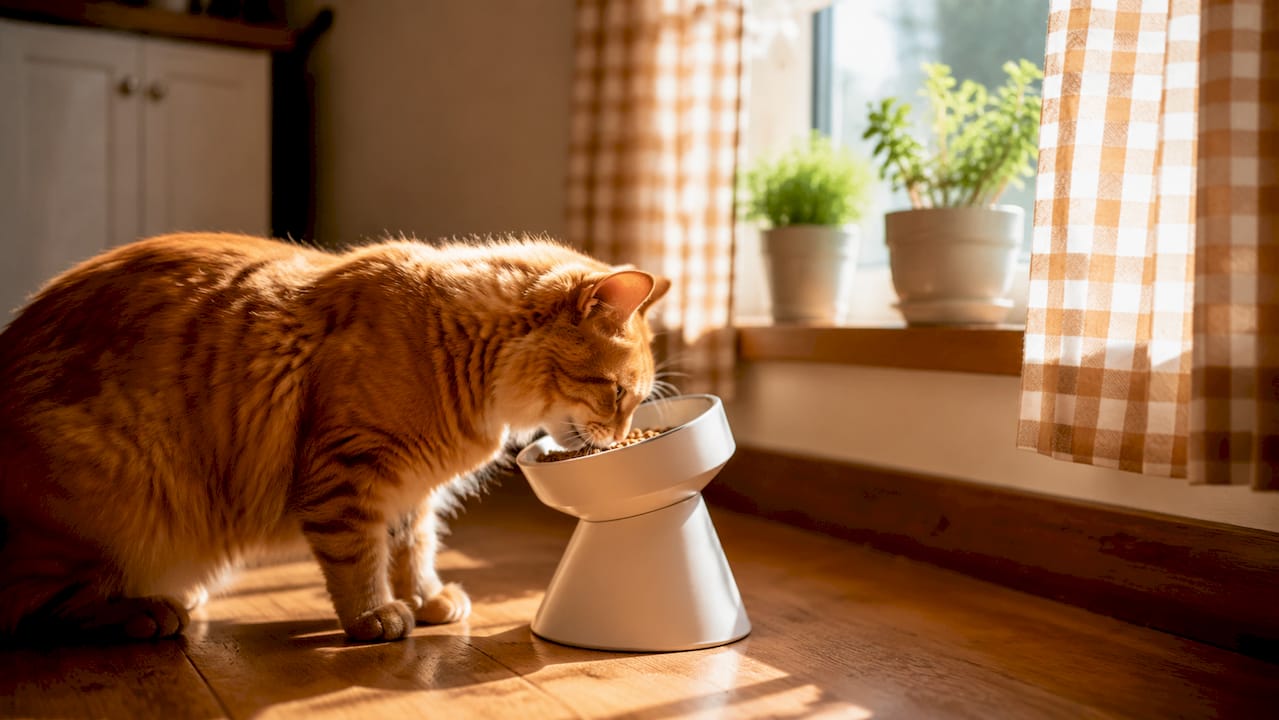
Senior cats gain the most from raised feeders, but younger cats benefit too. A more natural eating posture means food travels down the esophagus with less resistance, which can reduce post-meal vomiting. For cats that eat too fast or tend to regurgitate, a raised dish is often the first practical fix to try before anything more involved.
Whisker fatigue is another real concern, even if the clinical evidence is still developing. Wide, shallow bowls reduce the contact between a cat’s sensitive whiskers and the bowl’s edges. Feeding behavior experts recommend trying this kind of bowl as a low-risk first step before any clinical intervention for reluctant or anxious eaters.
- Reduces neck, back, and joint strain during meals
- Supports easier swallowing by aligning throat and esophagus
- Helps lower post-meal vomiting in prone cats
- Addresses whisker discomfort with wide, shallow designs
- Allows modular separation for multi-cat households
Pro Tip: The right height varies by cat. A general rule is to match the rim height to roughly your cat’s shoulder height when standing, so they eat with a slight downward tilt rather than a full neck drop.
Which design features actually matter in a raised food bowl?
Height and tilt work together. Optimal feeding height sits at an ergonomic rim level suited for most adult cats, keeping the neck in a relaxed position without forcing an awkward upward stretch. A 15-degree tilt keeps food centered in the bowl rather than sliding to the edges, which means less lateral head movement and less cervical stress during the meal.
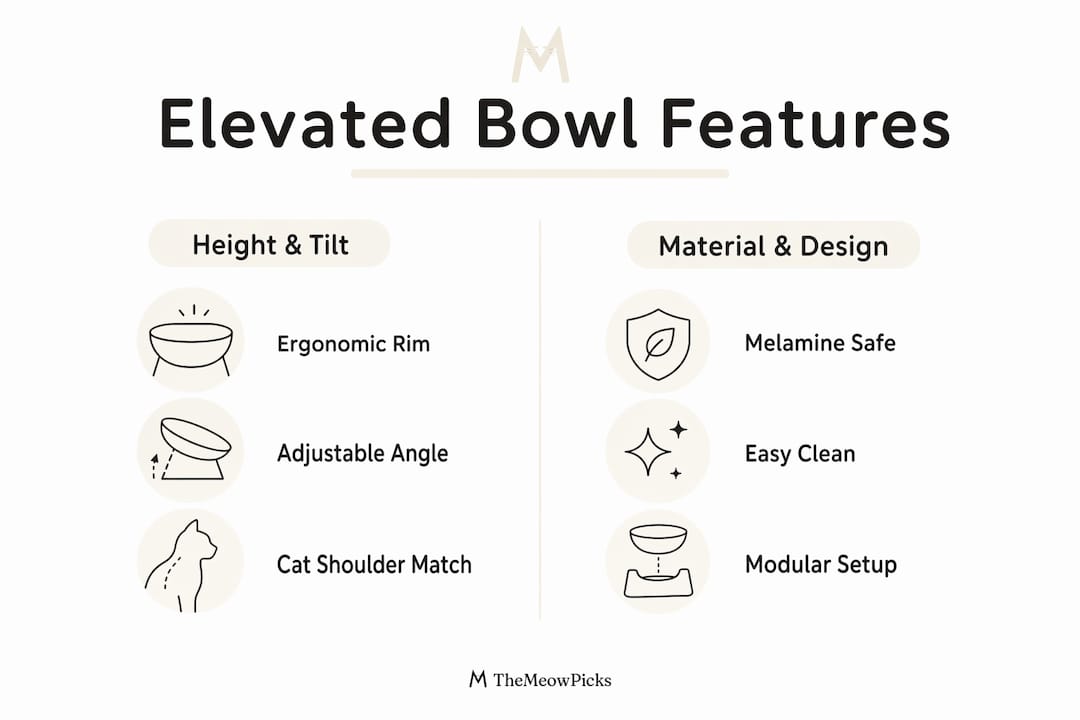
Bowl width matters as much as height. A dish that’s 6 inches or wider across the opening gives whiskers room to clear the rim entirely. Depth should stay shallow, closer to a plate than a cup, so your cat can access every last bite without pressing their face into the bowl.
Anti-slip bases and silicone pads are worth prioritizing. Many cat owners assume elevated feeders are spill-proof by design, but they aren’t. Pairing an elevated bowl with a
underneath is the most effective way to contain mess.
- Height: 5–6 inches at the rim suits most adult cats
- Tilt: A 15-degree angle keeps food centered and reduces neck movement
- Width: 6 inches or wider prevents whisker contact
- Base: Anti-slip silicone pads reduce sliding and floor noise
- Material: Melamine is lightweight and durable; ceramic bowls are heavier and easier to clean but more fragile; stainless steel resists bacteria and chin acne
- Cleaning: Dishwasher-safe, non-toxic materials keep hygiene simple
How do U.S. elevated cat bowl options compare?
CATASTROPHIC CREATIONS stands out as a verified American manufacturer with a focused product line built around ergonomic feeding. Their elevated cat bowls are designed with thoughtful height and width specifications, premium materials, and a tilt that keeps food accessible without scattering.
| Product | Material | Height & Tilt | Design Features | Ease of Cleaning | Best For | Rating |
|---|---|---|---|---|---|---|
| CATASTROPHIC CREATIONS Elevated Cat Bowls | Premium materials | Ergonomic height, tilted design | Wide, shallow bowl; anti-slip base | Dishwasher safe | Cat owners wanting U.S.-made ergonomic feeders | 4.9★ (216 reviews) |
Beyond CATASTROPHIC CREATIONS, the U.S. market offers a range of raised cat dish options across different materials and price points. Ceramic elevated cat bowls like those from CEEFU offer a rim height around 5 inches, bowl width wider than 6 inches, and lead-free construction, making them a solid pick for cat owners who prioritize hygiene and aesthetics. The Neater Feeder Deluxe, made in the USA, takes a different approach: its enclosed frame contains spills, and optional leg extensions bring the feeding height to a slightly elevated rim height, with shallow bowls designed specifically for cats’ sensitive whiskers.
For cat owners who want a stainless steel option, the Catit PIXI Elevated Feeding Dish keeps things simple with a shallow, whisker-friendly steel dish set into a cat-themed holder. It won’t tip, it’s dishwasher safe, and it comes with a spare dish so cleaning never interrupts mealtime.
What to look for in any U.S. option:
- Verified food-safe, non-toxic materials with appropriate certifications
- Rim height designed to match an ergonomic level for adult cats
- Wide, shallow bowl profile (6 inches or wider)
- Anti-slip base or silicone pad included
- Dishwasher-safe construction
How to choose the right elevated cat bowl for your cat
Start with your cat’s size and age. A kitten or small adult cat needs a lower rim height than a large Maine Coon. Senior cats or those with arthritis benefit most from the full 5–6 inch height range, since bending down even slightly can cause discomfort over time. If you’re caring for a Maine Coon or large breed, sizing up on both height and bowl width pays off.

Consider your household setup. Multi-cat homes do better with modular feeders that separate into individual bowls, reducing the tension that comes when cats share a single station. If you have a dog in the house, a wall-mounted raised feeder keeps the cat’s food completely out of reach.
Material choice comes down to your priorities. Melamine is lightweight and drop-resistant, making it practical for active cats. Ceramic and porcelain look beautiful and clean easily, but they’re heavier and can chip. Stainless steel resists bacteria and is the best choice for cats prone to chin acne.
Finally, plan for the transition. Most cats accept a new bowl within a few days, but placing the elevated dish next to the old floor bowl first helps. Gradually move the floor bowl away over a week or so, and your cat will shift to the raised feeder naturally.
What do ergonomic experts say about feeding posture?
The core principle behind elevated feeding is spinal alignment. When a cat eats at floor level, the neck flexes sharply downward, compressing the cervical vertebrae and making swallowing harder. Raising the bowl to shoulder height keeps the throat and esophagus in a straighter line, so food moves down with less effort.
The 15-degree tilt standard comes from observing how cats naturally position their heads when eating at a comfortable height. A tilted bowl means the cat’s head stays relatively still during the meal rather than shifting side to side to chase food around the dish. That reduction in lateral movement is what makes the tilt genuinely useful, not just a design detail.
Purina’s feeding guidance specifically calls out senior and arthritic cats as the group that benefits most from raised feeders. For these cats, the combination of elevation and tilt can make the difference between a comfortable meal and one that causes visible discomfort. Feeding behavior specialists also note that switching to a wide, shallow, raised bowl is one of the lowest-risk interventions available for cats that eat reluctantly or show signs of whisker stress.
The ergonomic height isn’t a fixed number. It depends on your individual cat’s shoulder height, so a bowl that works perfectly for one cat may be too high or too low for another.
Are there any risks to elevated feeding?
Elevated bowls are safe for the vast majority of cats, but a few considerations are worth knowing. The most widely discussed concern involves large-breed dogs, not cats: some research has linked elevated feeders to bloat (gastric dilatation-volvulus) in deep-chested dog breeds. That risk does not apply to cats, whose anatomy and eating patterns differ significantly.
For cats, the main practical risk is choosing the wrong height. A bowl set too high forces an upward neck stretch that creates its own strain, essentially trading one problem for another. Sticking to the 5–6 inch rim height guideline for adult cats avoids this.
Material safety is the other factor to check. Plastic bowls can harbor bacteria in surface scratches and have been linked to feline chin acne in some cats. Ceramic, porcelain, and stainless steel are all safer long-term choices, provided they’re certified lead-free and cadmium-free.
The Meow Picks carries elevated feeders worth looking at
If you want an elevated feeder that fits a modern home without looking like pet equipment, The Meow Picks curates a range of designer options from independent makers. The Desco elevated feeder in porcelain and the Arco steel feeder are two standouts: both are built for ergonomic comfort, easy cleaning, and the kind of aesthetic that actually belongs on a kitchen floor.

Every purchase at The Meow Picks supports cat rescue organizations, so your cat eats better and another cat gets a second chance. Browse the full elevated feeder collection to find the right fit for your cat’s size, your home’s style, and your cleaning routine.
Key Takeaways
Elevated cat bowls reduce neck and spine strain by raising the dish to an ergonomic height, with 5–6 inches at the rim and a 15-degree tilt being the most effective combination for adult cats.
| Point | Details |
|---|---|
| Optimal height | Aim for 5–6 inches at the rim to match your cat’s shoulder height and reduce neck strain, as corroborated by ergonomic experts and Uahpet’s feeding recommendations. |
| Tilt angle | A 15-degree tilt keeps food centered and minimizes lateral head movement during meals. |
| Bowl width | Choose a dish 6 inches or wider to prevent whisker contact and reduce feeding stress. |
| Senior cats | Cats with arthritis or mobility issues benefit most from raised feeders, per Purina’s feeding guidance. |
| The Meow Picks | Carries designer elevated feeders in porcelain and steel from independent makers, with a portion of every order supporting cat rescue. |