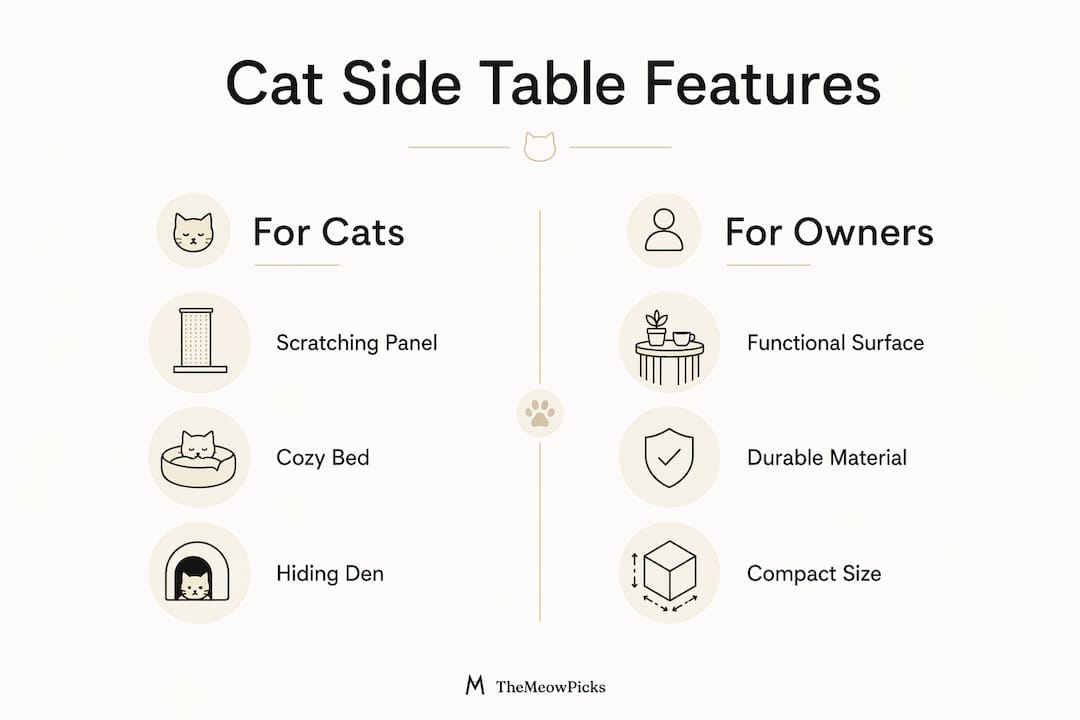
A cat side table is exactly what it sounds like: a piece of furniture that pulls double duty as a functional end table for you and a cozy, cat-friendly space for your feline. The best designer models go well beyond a simple shelf with a hole cut in it. They combine a stable surface for your lamp, book, or morning coffee with built-in features your cat will actually use, like sisal scratching panels, cushioned napping dens, and multi-entry openings that give curious cats a sense of control over their space.
Here’s why a designer multifunctional model is worth choosing over a basic cat bed or a plain side table:
- Space-saving design: One piece replaces two, which matters in apartments and smaller living rooms.
- Aesthetic appeal: Quality materials like solid wood, tempered glass, and resin blend with modern home decor instead of clashing with it.
- Cat-centric features: Sisal rope scratching surfaces protect your actual furniture; enclosed dens give anxious cats a retreat.
- Stable tops: Most designer models support household items comfortably, with typical surface heights between 18 and 24 inches.
- Compact footprint: Standard widths run 15–20 inches, so the table fits beside a sofa or bed without crowding the room.
Table of Contents
- What features and materials make a cat side table worth buying?
- What dimensions and specs should you look for?
- What do customers actually say about these tables?
- How do you choose the right cat side table for your home?
- Where can you buy a cat side table, and is it in stock?
- How much does a cat side table cost?
- How long does shipping take?
- How does a cat side table compare to other pet furniture?
- How durable are these tables, and how do you maintain them?
- Why The Meow Picks takes curation seriously
- The Meow Picks has the designer cat furniture your home deserves
- Key Takeaways
What features and materials make a cat side table worth buying?
The materials a pet side table is built from determine how long it lasts and how well it holds up to daily cat use. Solid wood, like the construction used in the Eureka Ergonomic Multi-Functional Cat Bed & Side Table, offers natural durability and a warm aesthetic. MDF with a waterproof coating, as seen in the Lantine Cat End Table, resists moisture and is easy to wipe clean. Resin bases paired with tempered glass tops, like the Eureka Ergonomic Enchanting Cat Side Table, bring a sculptural, decorative quality that works as a conversation piece.
Cat-centric features vary widely across designs:
- Sisal scratching surfaces: Wrapped posts or interior panels redirect scratching away from sofas and rugs. The Bailey Cat Scratcher end table, for example, includes three interior sisal surfaces and can be assembled in multiple orientations.
- Enclosed dens vs. open-corner beds: Enclosed models with small entry cutouts suit cats that prefer privacy. Open-corner designs, like the Eureka Ergonomic solid wood model, work better for cats that like to sprawl and be seen.
- Removable, washable cushions: A non-negotiable for hygiene. Look for cushions that zip off and go straight into the washing machine.
- Casters: Smooth-rolling wheels let you reposition the table for cleaning without lifting it, a small detail that makes a real difference over time.
- Multi-entry openings: Four-sided access, as featured on the Peek-a-Boo Cat Bed & Side Table, improves airflow and lets your cat choose how they enter and exit.
| Feature | Purpose | Common Materials |
|---|---|---|
| Sisal scratching panel | Redirects scratching behavior | Natural sisal rope |
| Enclosed den | Privacy for anxious or shy cats | MDF, solid wood |
| Removable cushion | Easy cleaning and hygiene | Polyester, cotton blend |
| Tempered glass top | Durable, easy-to-clean surface | Tempered glass |
| Casters | Mobility for repositioning | Rubber-wheeled plastic |
| Open-corner nook | Suits active, social cats | Solid wood, MDF |
Pro Tip: If your cat is a dedicated scratcher, prioritize models with sisal rope posts or panels over carpet-covered surfaces. Sisal holds up longer and is more satisfying for cats to scratch. If your cat is shy or easily startled, an enclosed den with a single small entry gives them a retreat that feels genuinely safe.
What dimensions and specs should you look for?
Sizing matters more than most buyers realize. A table that’s too tall sits awkwardly beside a low sofa; one that’s too wide crowds a small bedroom. Most cat furniture in this category falls within a predictable range, but the differences between models add up.
| Model | Dimensions (W x D x H) | Top Load Capacity | Cat Bed Capacity |
|---|---|---|---|
| Eureka Ergonomic Multi-Functional (solid wood) | 15.94" x 15.94" x 18.31" | Not listed | ~15 lbs |
| Peek-a-Boo Cat Bed & Side Table | 17.72" x 17.72" x 17.91" | 40 lbs | ~15 lbs |
| Lantine Cat End Table | 31.5" x 15.75" x 23.62" | Not listed | ~15 lbs |
| Bailey Cat Scratcher End Table | 20.75" x 15" x 23.75" | Not listed | N/A |
| Eureka Ergonomic Enchanting Cat Side Table | 20.87" x 7.87" x 23" | Tempered glass top | N/A |
The Peek-a-Boo model’s top load capacity is designed to hold a typical assortment of household items like a lamp, a book, a glass of water, and a phone charger without concern. For smaller spaces, the solid wood Eureka Ergonomic model’s 15.94-inch square footprint is genuinely compact. The Lantine’s wider 31.5-inch profile suits a living room corner better than a tight bedroom spot.
For cats, the opening size of the den matters as much as the overall dimensions. Openings are generally sized to accommodate most domestic cats comfortably, though very small openings may discourage larger or older cats from using the space.
What do customers actually say about these tables?
Customer feedback on multifunctional pet side tables is consistently positive on a few specific points. Assembly tends to be straightforward, often under 30 minutes, with most buyers noting that instructions are clear and hardware is included. The Eureka Ergonomic Enchanting Cat Side Table, for instance, draws repeated praise for its five-minute assembly time and the precise alignment of its glass tray edges.
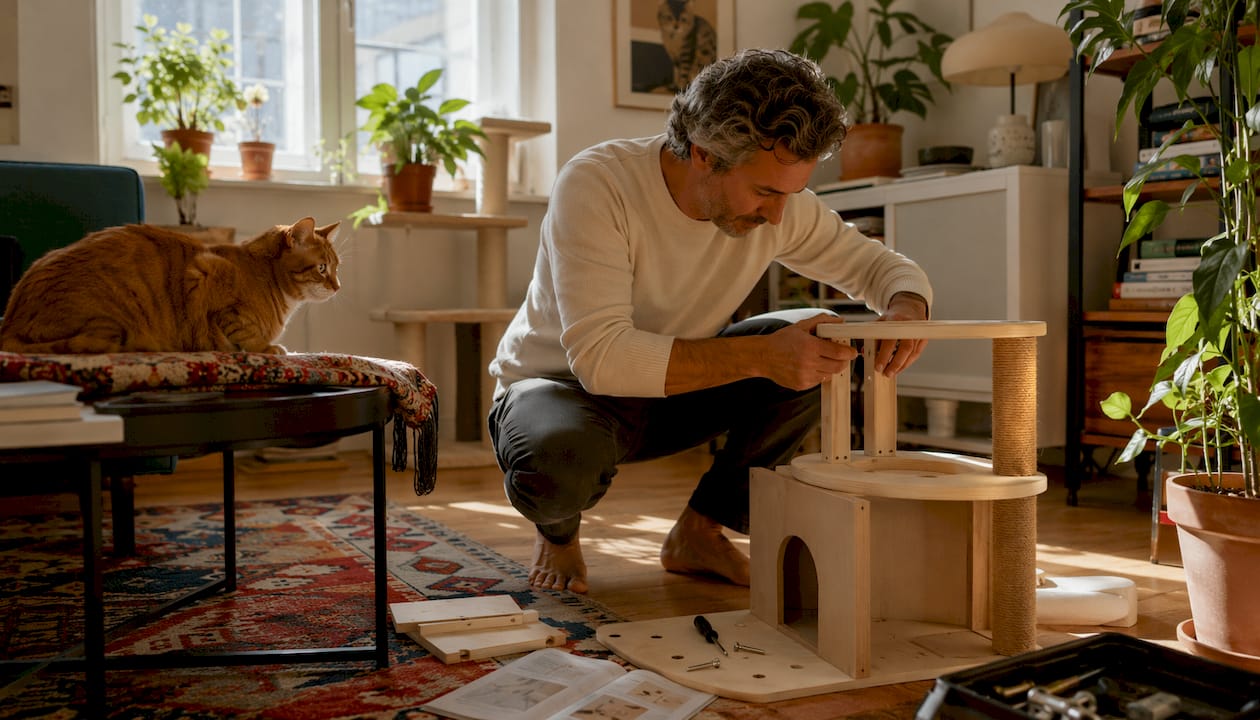
Design satisfaction runs high across the category. Buyers frequently mention that these pieces look far more like real furniture than typical cat products, which matters when the table sits in a main living area.
Common praises across customer reviews:
- Cats adopt the bed or den quickly, often within the first day
- Sisal posts show real wear after months of use, confirming cats prefer them over furniture
- Washable cushions hold up well through repeated machine washing
- The tables feel stable and don’t wobble when cats jump on or off
A few recurring concerns are worth knowing: some buyers find that enclosed models with a single entry can trap odors if the cushion isn’t washed regularly. A handful of reviewers note that cats on the larger end (over 12 pounds) may find smaller dens tight. Neither issue is a dealbreaker, but both are worth factoring into your choice.
How do you choose the right cat side table for your home?
Start with your cat, not your decor. An anxious cat that hides under the bed will thrive in an enclosed den model with a small, single entry. An active, social cat that follows you from room to room will likely ignore an enclosed space and prefer an open-corner nook where they can watch the room. Understanding your cat’s habits before you buy saves you from returning a perfectly good table that just doesn’t match your cat’s personality.
Once you know what your cat needs, layer in the practical considerations:
- Room footprint: Measure the space beside your sofa or bed before ordering. A 16-inch square table fits almost anywhere; a 31-inch wide model needs a deliberate spot.
- Surface height: Match the table height to your sofa arm or bed frame so it functions as a true nightstand or end table, not just a cat house with a shelf.
- Cleaning ease: Removable cushions and smooth, wipeable surfaces are worth paying extra for. Cat hair and dander accumulate fast.
- Scratching needs: If your cat already scratches furniture, choose a model with prominent sisal posts or panels, not just a small interior scratching surface.
- Multifunctionality: The best models serve as bed, scratcher, and table simultaneously. If you’re short on space, that triple function is the whole point.
Pro Tip: Spend a few days watching where your cat naturally rests and scratches before choosing a style. A cat that sleeps pressed against the sofa base will love a low, open-corner model placed right there. A cat that retreats to closets wants an enclosed den. Your cat is already telling you what they need.
For more ideas on keeping your indoor cat comfortable and engaged, including tasty rewards, the guide on premium cat treats like Greenies Feline Smartbites Healthy Indoor Tuna is a good companion read.
Where can you buy a cat side table, and is it in stock?
Designer cat side tables are available through several channels in the United States. Specialty pet furniture marketplaces, curated design shops, and larger retailers like Target all carry options at different price points. Availability varies by model and season; popular designs from independent makers can sell out quickly, particularly around the holidays.
The Meow Picks sources from independent designers worldwide, which means some pieces are made in smaller production runs. Checking stock before you fall in love with a specific model is always a good idea.
How much does a cat side table cost?
Entry-level models with basic MDF construction and minimal cat features start around $50–$80. Mid-range tables with solid wood frames, sisal posts, and washable cushions typically run $120–$200. Designer or sculptural pieces, like resin-and-glass decorative cat tables, can reach $189 and above. The Eureka Ergonomic Enchanting Cat Side Table, for example, is priced at $189.
Total cost considerations beyond the sticker price include shipping (often free on orders over a threshold), replacement cushions if yours wears out, and any assembly tools you might need (most kits include everything).
How long does shipping take?
Standard shipping for cat side tables within the United States typically takes 5–10 business days for in-stock items. Expedited options, where available, can cut that to 2–3 business days. Items sourced from independent or international makers may carry longer lead times, sometimes 2–4 weeks, depending on the maker’s location and production schedule.
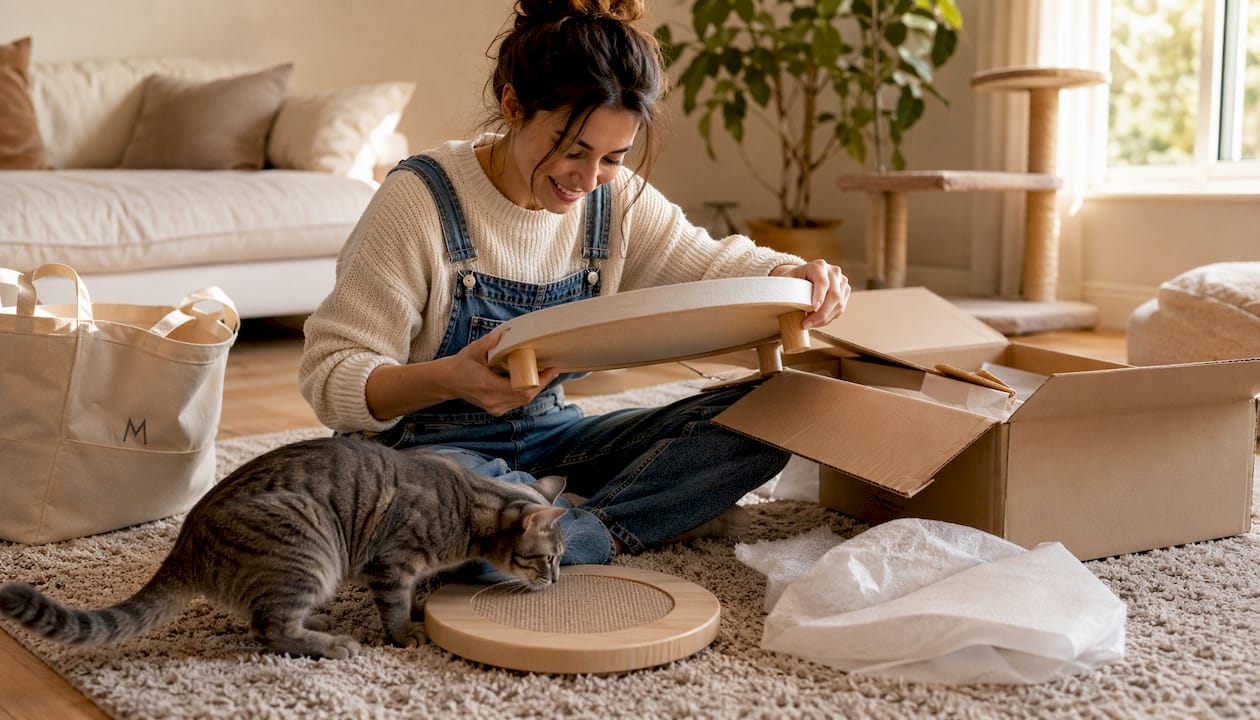
Always check the estimated delivery window at checkout, especially if you’re buying as a gift or need the piece by a specific date.
How does a cat side table compare to other pet furniture?
A standalone cat tree gives your cat more vertical climbing space but takes up a significant floor footprint and rarely doubles as usable human furniture. A wall-mounted cat shelf solves the floor-space problem but requires drilling and offers no surface for your belongings. A basic cat bed is portable and affordable but does nothing for scratching needs or your decor.
A cat side table sits in a practical middle ground. It’s smaller than a cat tree, requires no installation, and actually serves your home as furniture. The trade-off is that it won’t satisfy a cat that craves height or extensive climbing. For cats that primarily want a cozy spot to nap near you, it’s often the most sensible choice. If your cat needs more vertical enrichment, pairing a side table with a modern cat tree alternative covers both needs without overwhelming your space.
How durable are these tables, and how do you maintain them?
Solid wood models hold up the longest under regular cat use. MDF is durable when the finish is intact but can swell if water penetrates a chipped edge. Resin bases are nearly indestructible for normal use. Sisal scratching surfaces wear down over time, which is actually a sign they’re working. Most sisal panels can be replaced or rewrapped when they become too frayed.
For day-to-day maintenance: vacuum or lint-roll the cushion weekly, wipe down the table surface with a damp cloth, and wash the cushion cover monthly or whenever it smells. Avoid harsh chemical cleaners on wood or MDF surfaces; a mild soap solution is enough. Tables with casters should have the wheels checked occasionally to make sure they roll freely and haven’t collected hair around the axle.
With regular care, a quality cat side table should last several years before any structural wear becomes noticeable.
Why The Meow Picks takes curation seriously
Most cat furniture on the market is designed to appeal to cats or to owners, rarely both at once. The pieces that genuinely do both tend to come from independent designers who think carefully about material quality, structural integrity, and how a piece actually lives in a home. That’s the gap The Meow Picks was built to fill.
What concerns us about the broader market isn’t the price range or the style options. It’s the number of products that look good in a product photo and disappoint in person: wobbly bases, cushions that pill after two washes, sisal that unravels in weeks. When you’re buying something that sits in your living room and your cat uses every day, those details matter more than the listing suggests.
The curation process at The Meow Picks filters for exactly those details. Every piece in the catalog comes from an independent maker whose work has been evaluated for build quality, pet safety, and design integrity. The fact that a portion of every order supports cat rescue isn’t a marketing line; it’s the reason the brand exists. Buying well-made cat furniture and supporting cats in need aren’t separate things here.
If you’re choosing between a generic option and something designed with real care, the difference shows up not on day one but on day 300.
The Meow Picks has the designer cat furniture your home deserves
Cat owners who’ve spent time searching for a side table that actually looks good and works for their cat know how rare that combination is. The Meow Picks curates exactly that: designer pieces from independent makers that earn their place in your home while giving your cat a space they’ll genuinely use.
The catalog includes the Torre Cat Tower for cats that need more vertical space, the Kip Cat Bed for cats that want a dedicated cozy spot, and The Cat Nest Bed for a softer, more sculptural option. Every purchase supports cat rescue, so your cat’s comfort contributes to the comfort of cats still waiting for a home. Browse the full collection at The Meow Picks and find the piece that fits your space, your style, and your cat.
Key Takeaways
A well-chosen cat side table replaces two pieces of furniture, gives your cat a dedicated space to scratch and rest, and keeps your home looking like a home rather than a pet supply store.
| Point | Details |
|---|---|
| Dimensions to expect | Most models run 15–20 inches wide and 18–24 inches tall, fitting beside sofas and beds. |
| Top load capacity | The Peek-a-Boo model’s top load capacity comfortably holds typical household items. |
| Material matters | Solid wood lasts longest; MDF is budget-friendly; resin adds decorative appeal. |
| Match design to your cat | Enclosed dens suit anxious cats; open-corner nooks work better for social, active cats. |
| The Meow Picks | Curates designer cat side tables and related furniture from independent makers, with every purchase supporting cat rescue. |