The best cat tree for apartment living is tall, narrow, and properly anchored — giving your cat real vertical territory without eating up your floor space. If you want a quick answer before diving deeper, here are three solid starting points:
- Narrow freestanding tower: The Torre Cat Tower from The Meow Picks delivers a slim footprint with stacked platforms and a modern aesthetic that actually belongs in a living room.
- Tension-anchored vertical system: A floor-to-ceiling tension pole tree (adjustable range typically 95–107 inches) secures using ceiling pressure rather than a wide, heavy base — ideal for renters who can’t drill.
- Integrated furniture options: The Kip Cat Bed and The Cat Nest Bed from The Meow Picks double as stylish home pieces while giving your cat a cozy, enclosed retreat.
Wirecutter’s hands-on testing of nine cat trees confirmed that compact models with solid, multi-pillar platform support outperform wider, cheaper alternatives on both stability and longevity. Rover’s apartment-focused design guidance reinforces the same principle: in small spaces, vertical territory matters more than horizontal spread.
Table of Contents
- What are the best cat trees for apartments right now?
- How do you choose the right cat tree for a small apartment?
- What are the best space-saving alternatives to a traditional cat tree?
- How do you make a cat tree stable and safe in an apartment?
- Expert tips for multi-cat homes and very small apartments
- What’s the best overall approach for apartment cat owners?
- Key Takeaways
- Why vertical-first design is the right call for apartment cats
- Designer cat furniture built for your apartment, ready to ship
What are the best cat trees for apartments right now?
Finding the right fit comes down to matching a product’s footprint, height, and build quality to your actual space. Here are the top categories and specific picks worth knowing.
Torre Cat Tower — The Meow Picks’ flagship vertical tower is built for apartments where floor space is tight but ceiling height gives you room to work with. Its slim base and stacked perch design prioritize height over sprawl, and the clean, modern finish means it won’t look out of place next to your sofa. Best for single cats or a bonded pair in a studio or one-bedroom.
Kip Cat Bed — A low-profile, designer-forward option for apartments with lower ceilings or owners who prefer a ground-level cozy spot over a climbing structure. The Kip’s minimal silhouette fits naturally into a bedroom or reading nook. Think of it as the cat furniture equivalent of a well-chosen throw pillow.
The Cat Nest Bed — An enclosed condo-style retreat that gives cats the covered security they crave without demanding much floor space. Works especially well as a complement to a taller tower in multi-cat homes, or as a standalone option for a single cat who prefers hiding to climbing.
Compact 2-level designer towers — For renters who want something between a bed and a full tower, compact two-level models like the Catry Eclipse (23" L × 15" W × 30" H, assembled weight 22 lbs) show how much you can pack into a small footprint: a quilted velvet condo, recycled-paper scratching post, and a plush perch bed. Mid-range price, minimal assembly.
Wall-mounted shelf systems — The Meow Picks’ Maze wall shelves and climbing shelf take vertical territory off the floor entirely. Installation requires wall anchors, so check your lease first. Premium price tier, but they read as décor rather than pet equipment.
Tension-pole trees — Lightweight (often under 20 lbs) and adjustable, these suit renters who move frequently. No drilling required. Budget to mid-range pricing, though stability varies by brand and ceiling texture.
Window perches — Single-perch options like The Meow Picks’ wall-mounted wooden perch give cats a bird’s-eye view without any floor footprint at all. Best for single cats in sun-facing apartments.
Pro tip on price tiers: Budget freestanding towers (under $80) tend to use thinner particleboard and single-post platforms that wobble within months. Mid-range ($80–$200) is where construction quality jumps noticeably. Designer and premium pieces (above $200) often use solid wood or metal hardware and are built to last several years in daily use.
How do you choose the right cat tree for a small apartment?
Start with one measurement before you look at any product: your available floor footprint. Then work upward.
Wirecutter’s testing found that platform width matters more than overall footprint — platforms under 15 inches wide are often too cramped for an average adult cat to stand, turn, or stretch comfortably. The practical recommendation is 15–19 inches of usable platform width, even if the base footprint is compact.
| Measurement | Recommended Range | Why It Matters |
|---|---|---|
| Platform width | 15–19 inches | Minimum for a cat to stand, turn, and lounge comfortably |
| Base footprint (freestanding) | moderate size | Wide enough for stability without tipping |
| Ceiling tension pole range | adjustable height | Covers most standard 8 ft apartment ceilings |
| Tower height (narrow freestanding) | adequate height | Provides meaningful vertical territory in limited floor space |
| Weight capacity per platform | suitable load capacity | Accounts for jumping impact, not just resting weight |
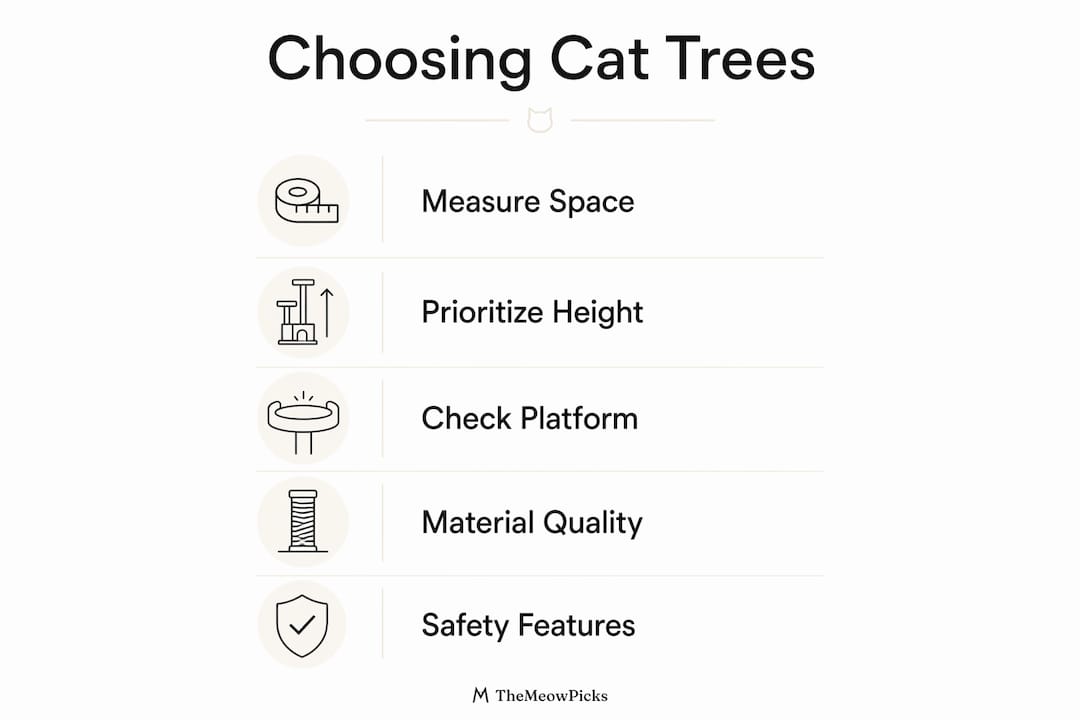
Your apartment-ready checklist:
- Measure your ceiling height and available floor footprint before ordering anything
- Check your cat’s weight and jumping style (heavy jumpers need wider, lower platforms; agile climbers can use taller, narrower designs)
- Count your cats — multi-cat homes need at least one perch per cat, ideally at different heights
- Decide on material preference: natural sisal and wood age better and stay cleaner than carpet, which traps dander and odors
- Look for removable, washable covers on condos and perch pads
- Check whether platforms have bolted or glued connections (bolted lasts longer)
- Review your lease before purchasing anything wall-mounted or ceiling-anchored
Pro Tip: When a trade-off is required between height and footprint, choose height. A taller, narrower tower on an 18-inch base gives your cat more usable territory than a short, wide model on a 24-inch base — and takes up less visual space in a small room. For comfort, platforms should be 15–19 inches wide.
For large-breed cats like Maine Coons, platform sizing becomes even more critical. Maine Coons can reach 18–25 lbs, so weight capacity and platform width both need to be at the higher end of the ranges above.
What are the best space-saving alternatives to a traditional cat tree?
Not every apartment has room for a freestanding tower, and not every renter wants one dominating the living room. These alternatives cover the full range of space constraints and style preferences.
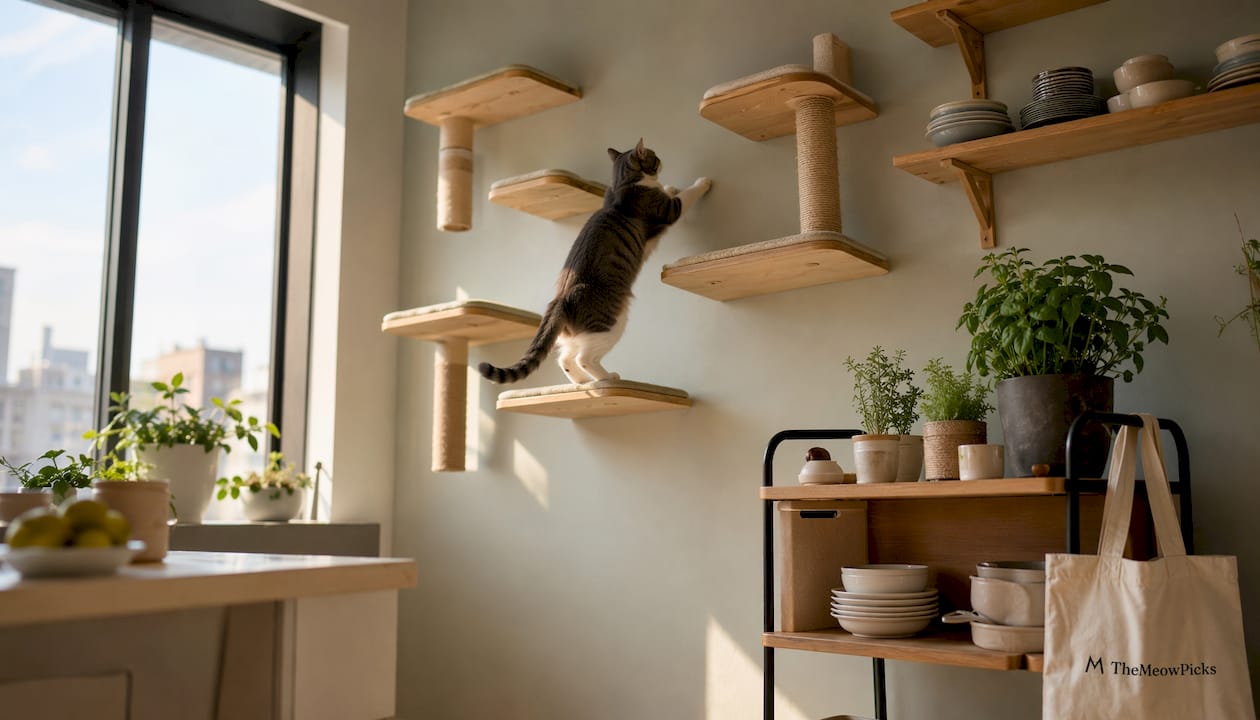
Wall-mounted shelves and cubbies are the most space-efficient option available. They take vertical territory completely off the floor and, when chosen well, look like intentional wall décor. The Meow Picks’ wall cubby doubles as a covered resting space and a design element. The trade-off: installation requires wall anchors, so you need landlord permission or a plan to patch holes when you move out.
Window perches suit single-cat apartments with a good sun exposure. A wooden wall-mounted perch positioned at window height gives your cat a lookout post, enrichment from watching birds and street activity, and warmth from the sun — all with zero floor footprint. These are among the most renter-friendly options since many mount with minimal hardware.
Tension poles work well for renters who want vertical climbing without drilling. They press between floor and ceiling using adjustable pressure, typically spanning 95–107 inches. Because they weigh under 20 lbs, they’re also easy to take down and reassemble when you move. The limitation is that ceiling texture (especially popcorn ceilings) can reduce grip, so always test stability before letting your cat use one.
Furniture with integrated condos — end tables, benches, and side tables with built-in cat spaces — are what Rover describes as the sleek double-duty solution for apartment dwellers focused on aesthetics. They keep the living space uncluttered while giving cats a retreat. The Cat Nest Bed fits this category well: it reads as a design object first, a cat bed second.
Modular climbing systems let you start with one or two shelves and expand as your budget and wall space allow. They’re reconfigurable, which is a genuine advantage for renters who rearrange frequently or move between apartments with different layouts. The Meow Picks’ cat trees and towers alternatives guide covers several modular options worth exploring.
Scratcher-anchored options — wall-mounted scratchers like The Meow Picks’ Artisticat wall scratchers — add enrichment and territory marking without any floor footprint. Pair them with a perch or shelf at the same height for a minimal but functional climbing zone.
How do you make a cat tree stable and safe in an apartment?
Stability is the single most important safety factor, and it’s often the first thing cut in budget designs. A tower that wobbles when your cat jumps onto it will get worse over time, not better.
- Inspect the base before assembly. Check that the base plate is solid, not hollow particleboard. A base measuring at least 18–22 inches across provides meaningful stability for towers up to 60 inches tall.
- Place on a non-slip surface. Hardwood and tile floors let bases slide during jumps. Use a high-friction mat or furniture pad under the base to prevent movement.
- Tighten all hardware after assembly. Most towers ship with Allen wrenches. Tighten every bolt before your cat uses it, and re-check after the first week of use.
- Add a wall anchor if your lease allows. A single furniture strap anchored to a stud can prevent a top-heavy tower from tipping during an energetic leap. These straps are the same type used for anti-tip furniture safety in homes with children.
- Use a tension rod for renter-friendly anchoring. If drilling is prohibited, a floor-to-ceiling tension pole tree eliminates the tipping risk entirely by pressing against the ceiling.
- Test with gradual loading. Before your cat uses it freely, press down on each platform with your hand to simulate jump impact. Any flex or wobble at this stage means the tower needs reinforcement or replacement.
- Secure loose toys and dangling attachments. In thin-wall apartments, rattling toys and swinging ropes create noise that travels. Tie off or remove loose attachments if neighbor noise is a concern.
A note on lease agreements: Drilled wall anchors require landlord permission in most rental agreements. Tension mounts and high-friction pads are universally renter-friendly. If you want wall-mounted shelves, ask in writing before installation — many landlords approve it when you commit to patching on move-out.
Noise is a real consideration in apartment buildings. Dense materials like solid wood and natural sisal absorb impact better than hollow posts wrapped in thin carpet. A tower that sounds like a drum kit every time your cat jumps is a neighbor-relations problem waiting to happen.
Expert tips for multi-cat homes and very small apartments
Multiple cats in a small apartment need more than one tower. The principle backed by both Wirecutter and Rover is straightforward: every cat needs its own perch, and perches should be at different heights to establish a natural hierarchy without conflict.
Wirecutter’s platform-width guidance — 15–19 inches of usable space per perch — applies even more strictly in multi-cat homes, where cats need room to sit without feeling crowded by a companion on the next level. Tiny platforms force proximity, which creates tension.
Specific tips that make a real difference:
- Place at least one perch near a window so cats have environmental enrichment (watching birds, feeling sunlight) that reduces boredom-driven conflict
- Use identical perches at different heights when possible — cats fight less over resources when the options look equivalent
- Spread resources vertically and horizontally: perches in different rooms or corners, not clustered in one spot
Pro Tip: In a studio apartment with two cats, a tall narrow tower near the window plus a wall-mounted perch on the opposite wall gives each cat a distinct territory without requiring a second full tower. The spatial separation matters as much as the number of perches.
Tension-pole trees with adjustable height work well in standard 8-foot apartment ceilings and give multiple cats staggered platforms without a wide base footprint. For modern cat furniture that serves both cats well while fitting the room, look for designs with at least three distinct platform levels and one enclosed condo space.
What’s the best overall approach for apartment cat owners?
If your apartment has limited floor space but reasonable ceiling height, a tension-anchored or narrow freestanding tower is your best starting point. Measure your available footprint and ceiling height first, then decide whether your lease permits wall anchors or ceiling tension mounts. That single decision narrows your options considerably and prevents a frustrating return.
For owners who want furniture that pulls double duty — looking good in the room while serving the cat — The Meow Picks’ Torre Cat Tower, Kip Cat Bed, and The Cat Nest Bed are the clearest examples of designer cat furniture that fits apartment living without compromise.
Key Takeaways
The most effective cat tree for an apartment prioritizes vertical territory, usable platform width of 15–19 inches, and renter-friendly anchoring over raw footprint size.
| Point | Details |
|---|---|
| Prioritize vertical territory | Tall, narrow towers give cats more usable space than short, wide models in small apartments. |
| Platform width over footprint | Platforms should be 15–19 inches wide; anything smaller is often unusable for an average adult cat. |
| Anchor for safety | Use wall straps, high-friction pads, or tension poles to prevent tipping — check your lease before drilling. |
| Choose designer-integrated pieces | Furniture like the Torre Cat Tower, Kip Cat Bed, and The Cat Nest Bed from The Meow Picks fits apartment décor while meeting cats’ needs. |
| Distribute resources in multi-cat homes | Place perches at different heights and near windows to reduce conflict and boredom in small spaces. |
Why vertical-first design is the right call for apartment cats
Most cat furniture advice focuses on what cats need in the abstract — scratching, climbing, hiding. What apartment owners actually need is furniture that solves two problems at once: enriching the cat and fitting the home. Those goals are not in conflict, but most budget cat trees treat them as if they are, producing pieces that are neither comfortable for the cat nor tolerable for the owner to look at.
The vertical-first approach works because it respects how cats actually use space. A cat on a high perch feels secure, stimulated, and in control of its environment. That’s not a luxury — it’s a behavioral need that, when unmet, shows up as anxiety, destructive scratching, or inter-cat conflict. Choosing a tall, well-built tower over a sprawling carpet structure isn’t just an aesthetic preference. It’s the more honest solution for a cat living in 600 square feet.
The Meow Picks curates pieces from independent makers who understand this. The Torre, Kip, and Cat Nest aren’t compromises between style and function — they’re designed from the start to serve both. And because a portion of every order supports cat rescue, buying well-designed furniture also supports cats who don’t yet have a home to furnish.
Designer cat furniture built for your apartment, ready to ship
If you’ve measured your space and know what you need, The Meow Picks makes the next step straightforward. The Torre Cat Tower is the go-to for vertical-first apartments — slim base, stacked platforms, and a finish that works in a modern living room. For a lower-profile option, the Kip Cat Bed fits naturally into bedrooms and reading corners. And The Cat Nest Bed gives cats the enclosed retreat they love without demanding much from your floor plan.
Every piece in The Meow Picks collection is sourced from independent, design-led makers and curated for quality, stability, and apartment compatibility. A portion of every order goes directly to cat rescue organizations. You can check orders and shipping details on the site before you buy. Browse the full range and find the piece that fits your space at The Meow Picks.
Selected sources and further reading
- Wirecutter: Best Cat Trees for Apartments — Hands-on testing of nine models; source for platform-width recommendations (15–19 inches) and stability criteria.
- Rover: Cat Furniture for Apartments — Apartment-focused design advice; source for tension-pole height ranges (95–107 inches) and double-duty furniture guidance.
- Catry Eclipse product page — Source for compact 2-level tower dimensions (23" L × 15" W × 30" H) and material details.
- The Meow Picks: Modern Cat Furniture Guide — Editorial guidance on choosing designer cat furniture that complements apartment interiors.
- Bellatrix Cattery: Why Choose a Maine Coon — Background on large-breed sizing considerations relevant to platform and weight-capacity choices.