Play-based food dispensers are the smartest way to feed and mentally stimulate an indoor cat, turning mealtime into a hunt instead of a handout. The Meow Picks Team has curated a set of enrichment-first pieces built around this idea, from activity toys to towers that support treat games, all available in the store. Start slow: supervise the first few sessions and stick to dry food unless a product page explicitly says otherwise.
TL;DR:
- High-energy or shy cats may struggle with complex puzzle feeders and respond better to simple gravity balls that dispense treats with minimal effort.
- Check treat opening sizes and adjustability to match your cat’s food size and skill level, ensuring the dispenser remains challenging but achievable.
- Motorized dispensers require batteries and periodic part replacements, making maintenance a key factor in long-term use and suitability for active cats.
- Introduce dispensers gradually through supervised sessions, starting with small amounts of dry food and increasing difficulty based on your cat’s comfort.
- DIY treat dispensers serve as affordable trial options but wear out quickly and should be replaced with secure, quality store-bought toys for lasting enrichment.
Table of Contents
- What Are the Best Cat Food Toy Dispensers?
- How Do Cat Food Dispensers Actually Work?
- What Should You Look For Before Buying?
- How Do You Introduce a Cat to a Food Dispenser Safely?
- Are DIY Cat Food Dispensers Worth Trying?
- Why We Curate Enrichment-First Pieces
- Where Can You Buy Starter Bundles for Enrichment Feeding?
- Sources
- FAQ
What Are the Best Cat Food Toy Dispensers?
A good cat food toy dispenser does one job well: it makes your cat work a little for each bite, which taps into the same stalk-chase-pounce sequence a mouse would trigger in the wild. That small bit of friction is the whole point. Food-dispensing toys mimic a cat’s hunting instinct, requiring your cat to problem-solve for a meal instead of just walking up to a bowl.
The Meow Picks catalog includes several pieces that turn feeding into a game, whether that’s a dedicated toy or a larger activity platform you can pair with treats. Here’s how each one fits into an enrichment routine.
Dedicated toy-style dispensers:
- Bosco Cat Toy: A compact interactive toy that works well for cats who are new to puzzle-style feeding. Best for cats who get frustrated with complicated mechanisms and need an easy entry point.
- Aperitivo Activity Toy: Built specifically to enable food-dispensing play, this one earns its spot as a go-to option for owners who want a single toy that does the enrichment job without extra setup.
Activity platforms you can pair with treat games:
- Apawtment Cat House: A design-forward cat furniture piece with enough structure to hide treats in different compartments, turning a simple house into a foraging exercise. Best for owners who want furniture that doubles as enrichment.
- Torre Cat Tower: A large activity platform with multiple levels, which makes it easy to scatter treats across different heights so your cat has to climb and search. Best for multi-cat homes or cats who like vertical exploration.
- Perla Cat Cave: A cozy hideaway that suits slower, low-key treat games rather than high-energy chasing. Best for shy cats who prefer to nibble somewhere private.
- The Grotto: A compact cat tree designed for tight apartments, where you can still tuck treats into ledges or corners. Best for small-space households that still want a foraging option.
- The Gardens: A modern activity tree with a botanical look that pairs naturally with enrichment feeding strategies. Best for owners who care about how the piece looks in the room as much as how it functions.
- The Crossroads: A wall-mounted scratcher and ramp combination that gives you vertical surfaces for placing treats along the climb. Best for cats who need to burn energy before they eat.
Every one of these pieces leans on the same principle: reduce boredom by giving your cat something to do before the reward shows up. Enrichment toys reduce boredom-related behaviors in indoor cats by encouraging movement and curiosity throughout the day, which matters most for cats who spend long stretches alone.
If you already have a small toy at home, something like the Mini Donuts Cat Toy makes a good pairing piece for hiding treats near a tower or cave.
Pro Tip: Rotate which product holds the treats each week. A cat that’s bored of the same feeding puzzle will often re-engage the moment you move the game to a different spot in the house.
How Do Cat Food Dispensers Actually Work?
Not every dispenser works the same way, and matching the mechanism to your cat’s personality matters more than picking whatever looks the flashiest online.
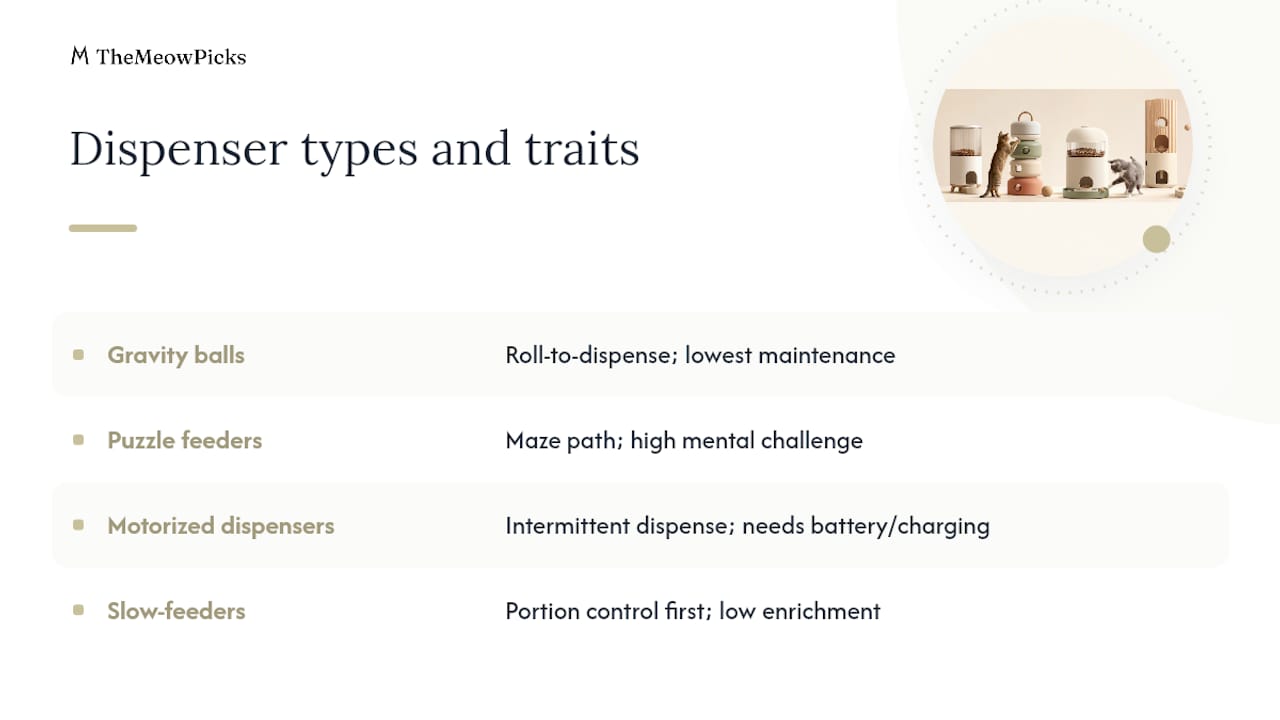
Gravity-and-rolling balls are the simplest design on the market. Your cat bats or rolls the ball, kibble falls through an opening, and the process repeats. Simple treat-dispensing balls rely on gravity and rolling motion, and many let you adjust the opening size to control how much food comes out per roll. Maintenance is low. There’s nothing to charge and little to break.
Puzzle feeders ask more of your cat’s brain. Instead of a single opening, food sits behind a maze-like path, so your cat has to nose, paw, or flip pieces around to extract each bite. These suit food-motivated cats who get bored fast and want a real challenge, not just a bowl with extra steps.
Motorized or spinning dispensers add unpredictability. Some models, like the paw-activated spinners from Catit’s PIXI line, use a self-righting design so the toy pops back upright after a swat, and dispense treats on an intermittent schedule rather than every single try. Manufacturer pages for Catit PIXI dispensers describe adjustable openings and list compatibility with dry treats up to 9 mm (0.4 in), which is worth checking before you buy if your cat’s regular treats run larger. These designs are great for active cats but come with a maintenance catch: they need batteries or charging, and some product listings mention replaceable teaser accessories that wear out before the motor does.
Slow-feeder bowls and combination feeders sit at the other end of the spectrum. They’re built for portion control first, enrichment second, which makes them a better fit for cats on a vet-recommended feeding schedule than for cats who need serious mental stimulation. If portion control is your main concern, our guide on automatic feeders and portion control breaks down that trade-off in more detail.
In terms of upkeep: gravity balls need the least attention, puzzle feeders need regular wiping, and motorized units need battery checks plus occasional part replacement. Noise varies too. Rolling balls click and clatter on hard floors, while puzzle feeders are mostly silent.
What Should You Look For Before Buying?
Buying the wrong dispenser usually isn’t a safety problem. It’s a “this just sits in the closet” problem. Answer these questions honestly before you add one to your cart.
- What’s your cat’s play drive? A food-obsessed, high-energy cat will tear through a puzzle feeder in minutes and get frustrated fast. A shy or older cat does better with a gravity ball that dispenses on the first few tries, building confidence before you increase the difficulty.
- Does the treat size match the opening? Check the product listing for maximum treat diameter. Some manufacturer pages list this precisely (Catit PIXI dispensers cap dry treats at 9 mm), and using the wrong kibble size means either nothing comes out or too much falls at once.
- How adjustable is it? Look for openings you can widen or narrow. A dispenser that only works at one difficulty setting will either be too easy on day one or too hard forever.
- Is it easy to clean? Some pieces are dishwasher safe, others need hand washing only. Follow whatever the product listing states rather than guessing, especially if you ever use anything other than dry kibble.
- Are there replaceable parts? Motorized spinners often have teaser attachments or battery compartments that need periodic replacement. Check whether the manufacturer sells refills before you commit to a battery-powered design.
Watch for a few red flags while you shop: unclear or missing treat-size specs, small detachable parts that could come loose during aggressive play, and battery-only designs with no mention of a safety cutoff if the motor jams. If a listing doesn’t say what size treat fits, don’t assume. Move on to one that does.
Pro Tip: If you’re not sure how food-driven your cat really is, start with an adjustable gravity ball before investing in a motorized spinner. It’s the cheaper way to find out.
How Do You Introduce a Cat to a Food Dispenser Safely?
Cats don’t automatically understand that a toy holds food. Go slow and let curiosity do the work.
- Session one: Preload a small amount of food, set it on the floor, and let your cat investigate without any pressure. Stay nearby to watch how they interact with it.
- Reward escalation: Once your cat gets a piece or two out, increase the difficulty slightly, whether that means narrowing the opening or moving to a maze-style puzzle.
- Stick to dry food: Unless the product page explicitly says otherwise, only use dry kibble or hard treats. Wet food left in a non-washable toy spoils fast and is harder to clean out of small openings.
- Clean on a schedule: Wipe down the dispenser regularly following whatever the manufacturer recommends, since crumbs and oils build up inside mazes and openings over time.
- Watch for frustration: If your cat bats the toy once and walks away repeatedly, the opening is likely too tight or the puzzle too advanced. Dial it back rather than pushing through.
- Know when to stop: If you notice a rapid change in weight, appetite, or behavior around feeding time, stop using the toy and talk to your vet. That’s a signal worth taking seriously, not troubleshooting alone.
Our piece on laser toy safety covers similar supervision principles if you’re building out a broader play routine alongside feeding toys.
Are DIY Cat Food Dispensers Worth Trying?
DIY dispensers have a real place, mostly as a cheap way to test whether your cat even likes puzzle feeding before you spend money on a manufactured toy. DIY treat dispensers are commonly published online as low-cost, temporary options, though they come with clear trade-offs against store-bought designs.
Safe options to try:
- A plastic bottle with holes cut for kibble to fall through, ends sealed securely so nothing sharp is exposed.
- Cardboard tube puzzles taped shut, letting your cat nose treats out through small openings.
- A snuffle mat, where kibble hides in fabric strips for your cat to sniff out.
Avoid anything with small loose parts that could detach, adhesives that break down when chewed or licked, and wet food in containers you can’t wash properly. DIY builds also wear out fast under determined chewing or batting, so they’re best treated as a trial run, not a permanent fixture. Once you know your cat loves the game, a manufactured toy with secure construction and, where relevant, safe electrics is the better long-term choice.
Why We Curate Enrichment-First Pieces

The Meow Picks Team looks for dispensers and activity furniture that treat feeding as a game, not just a mechanism. That framing matters: a meal-as-game mindset helps owners naturally manage portions while keeping their cat engaged, rather than treating a dispenser as an afterthought bought once and forgotten in a drawer.
We prioritize design-minded pieces because your home shouldn’t have to choose between looking good and keeping your cat busy. A portion of every order placed through The Meow Picks also goes toward supporting cat rescue organizations, so a purchase that keeps your own cat entertained does a little good beyond your living room too.
— TheMeowPicks Team
Where Can You Buy Starter Bundles for Enrichment Feeding?
If you’re starting from zero, pair one activity piece with one dedicated toy rather than buying five things at once. A simple combo like the Bosco Cat Toy alongside the Aperitivo Activity Toy covers both the low-effort gravity style and a more structured puzzle option, so you can see which your cat prefers before expanding further. For homes that want furniture doing double duty, the Apawtment Cat House or Torre Cat Tower both give you surfaces for hiding treats during climbing and exploring sessions.
Unlike big-box pet aisles where you’re stuck choosing between mass-produced plastic dispensers, The Meow Picks sources design-forward pieces from independent makers, so your cat’s enrichment gear doesn’t have to look out of place in your living room. Every listing on the site notes materials and dimensions exactly as the maker specifies them, which makes comparing options straightforward. Check orders and shipping details before you buy, and browse the Apawtment Cat House product page to start building your cat’s first foraging setup today.
Sources
- Interactive Cat Puzzle Feeder Toy, Adjustable Treat Dispenser Ball
- The best enrichment toys for indoor cats and how to use them properly
FAQ
What Is the Best Cat Food Dispenser Toy?
There’s no single best option since it depends on your cat’s play style, but a good starting point pairs an adjustable gravity ball or toy like the Bosco Cat Toy with a puzzle-style option like the Aperitivo Activity Toy so you can compare which style your cat prefers.
Are Treat-Dispensing Toys Good for Cats?
Yes. They mimic natural hunting behavior, which gives indoor cats mental stimulation and light exercise they might not otherwise get from a standard food bowl.
Are Puzzle Feeders Good for Cats?
Puzzle feeders work well for food-motivated cats who want more of a challenge, though they can frustrate shy or older cats who do better starting with a simpler gravity-ball design first.
How Do I Introduce My Cat to a Food Dispenser Toy?
Start with short, supervised sessions using a small amount of preloaded food, then gradually increase difficulty as your cat gets comfortable extracting treats on their own.
How Often Should I Clean a Cat Food Dispenser?
Clean on a regular schedule following the manufacturer’s instructions, and stick to dry kibble unless the product listing explicitly states it’s safe for wet food.