Laser toys are safe for most cats when used correctly, and the single most important rule is simple: never point the beam directly at your cat’s eyes or at any reflective surface. Follow that rule and a handful of others, and a laser toy becomes a genuinely useful tool for exercise and mental stimulation. Ignore it, and you risk real physical harm.
- The upside: Short laser sessions give cats a cardio burst and engage their natural prey drive, especially helpful for indoor cats who need more stimulation.
- The main risk: Without a satisfying “catch” at the end, laser play can leave cats frustrated, anxious, or stuck in obsessive chasing patterns.
Key Takeaways
Safe laser play depends on owner behavior and session structure far more than on the device itself. Choose a Class 1 labeled toy, keep sessions short, and always end with something your cat can physically catch.
| Point | Details |
|---|---|
| Never aim at eyes or reflections | Even low-wattage lasers can cause retinal damage; reflective surfaces spread the risk unpredictably. |
| End every session with a tactile catch | A physical toy or treat completes the hunting sequence and prevents frustration or obsessive behavior. |
| Choose Class 1 / ≤5 mW devices | Look for “Class 1 Laser Product” labeling and a printed mW rating; avoid any toy without power labeling. |
| Watch for red flags | Squinting, pawing at eyes, obsessive chasing, or redirected aggression all warrant a vet visit. |
| The Meow Picks curated play setup | Pair a labeled laser toy with tactile toys and safe furniture like the Torre Cat Tower for a complete, low-risk play environment. |
Table of Contents
- Why cats love lasers, and what can go wrong
- How to use laser toys safely: a step-by-step checklist
- What the label on a laser toy actually tells you
- Alternatives to laser-only play, and how to combine them
- When should you stop laser play and call a vet?
- Common myths about laser toys that are worth correcting
- The FDA and veterinary checklist for safe laser use
- Our take on lasers as part of a cat’s play life
- Safe play spaces and tactile toys from The Meow Picks
- Sources
Why cats love lasers, and what can go wrong
Cats are hardwired to track fast, erratic movement. Their eyes contain a high concentration of rod cells tuned to detect motion, which makes a darting red dot almost impossible to ignore. The laser triggers the full feline hunting sequence: stalk, chase, pounce. The problem is that the sequence never completes. There is nothing to catch, bite, or carry away.
The benefits, when play is structured well:
- Short sessions provide real cardio exercise, which matters for indoor cats prone to weight gain.
- The mental engagement of tracking and stalking reduces boredom-driven behaviors like furniture scratching or midnight zoomies.
- Some owners use laser movement to guide cats toward carriers or new spaces during training.
The two core risks are distinct, and each needs a different fix.
The first is physical: a laser beam aimed at the eye, even briefly, can cause retinal damage. The American Academy of Ophthalmology documents cases of permanent vision loss from pointer exposure and notes that higher-power lasers increase the risk of severe, sometimes painless, injury. Reflective surfaces like mirrors, glass, or polished floors can bounce the beam unpredictably, creating a hazard you did not intend.
The second risk is behavioral. When a cat never gets to “win,” the hunting drive stays activated without resolution. Over time, this can produce obsessive chasing behavior, redirected aggression toward people or other pets, or repetitive pacing. International Cat Care specifically recommends giving cats a way to complete the hunting sequence and monitoring individual responses, because some cats are more susceptible to frustration than others.
How to use laser toys safely: a step-by-step checklist
Getting cat laser toy safety right is less about the device and more about how you run the session. Follow these steps every time.
- Supervise every session. Never leave an automated laser toy running unattended. Cats can overheat, collide with furniture, or get the beam reflected into their eyes without you there to intervene.
- Keep sessions short. Aim for 5–10 minutes, once or twice a day. Longer sessions increase the chance of frustration and physical exhaustion.
- Clear the play zone first. Remove fragile items, block access to high ledges that could cause dangerous falls, and check for mirrors or glass surfaces that could reflect the beam. PetMD notes that cats in hunting mode can collide with furniture or jump dangerously, so a clear, open floor space is the safest setup.
- Keep the beam low and on the floor. Avoid aiming at walls above furniture or at heights that tempt your cat to leap onto unstable surfaces.
- Never aim at eyes or reflective surfaces. Even low-wattage lasers sold as toys are hazardous if aimed directly at the eyes, according to Hill’s Pet. This applies to your own eyes and to any other pets or people in the room.
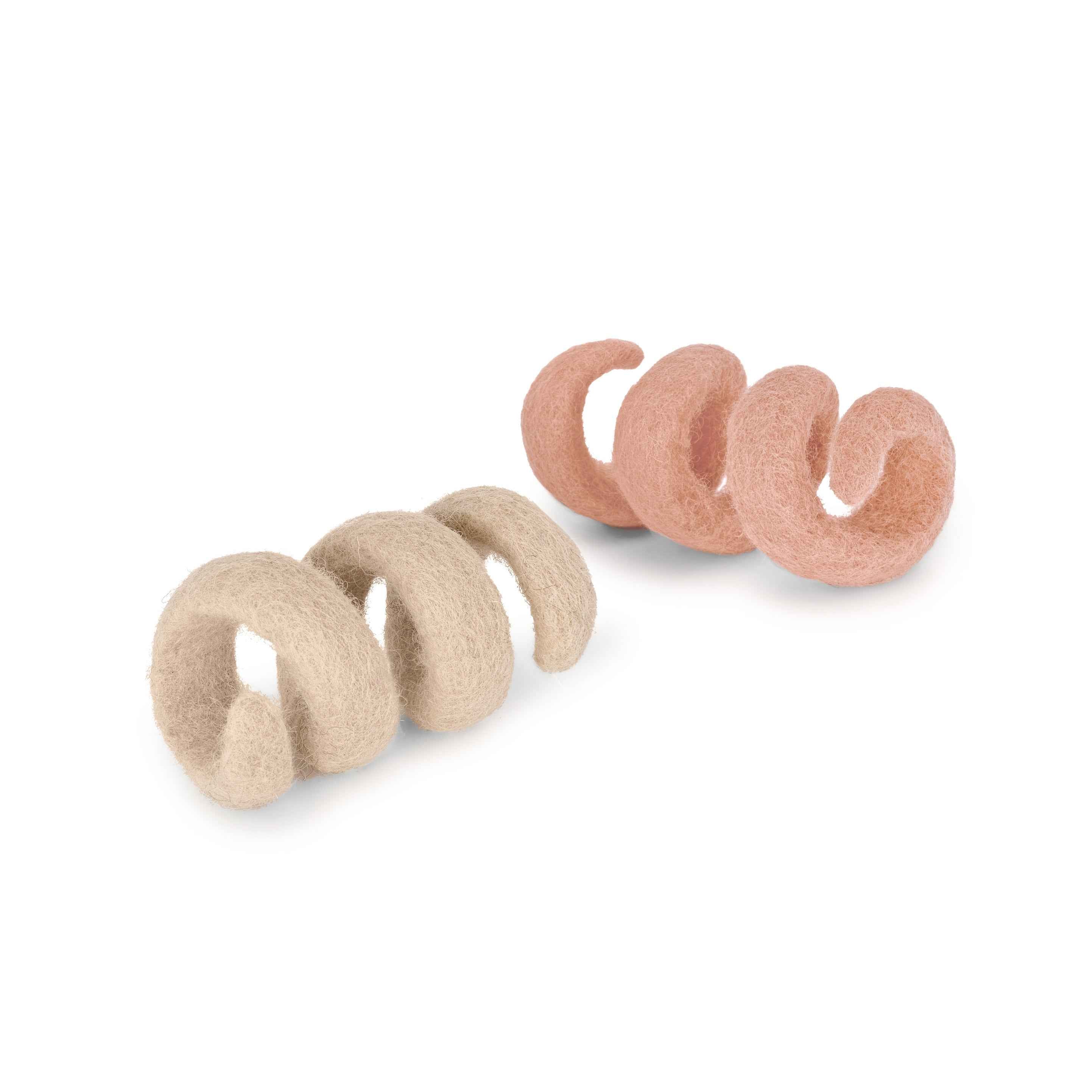
- End every session with a tangible catch. Slow the dot to a stop near a physical toy, like a felt animal toy, then let your cat pounce on it. Veterinarians recommend this transition to prevent frustration and obsessive behavior, and PetMD confirms that finishing with a physical toy or treat satisfies the hunting sequence.
- Store the device out of reach. Laser toys are small, battery-powered items. Button batteries are a serious ingestion hazard for cats and children alike. Put the toy away after every session.
Pro Tip: Watch your cat’s body language during play. Flattened ears, dilated pupils that stay wide even when the dot slows, or vocalizing after the session ends are signs the play is tipping into overstimulation. Shorten the next session and add a longer wind-down with a physical toy.
What the label on a laser toy actually tells you
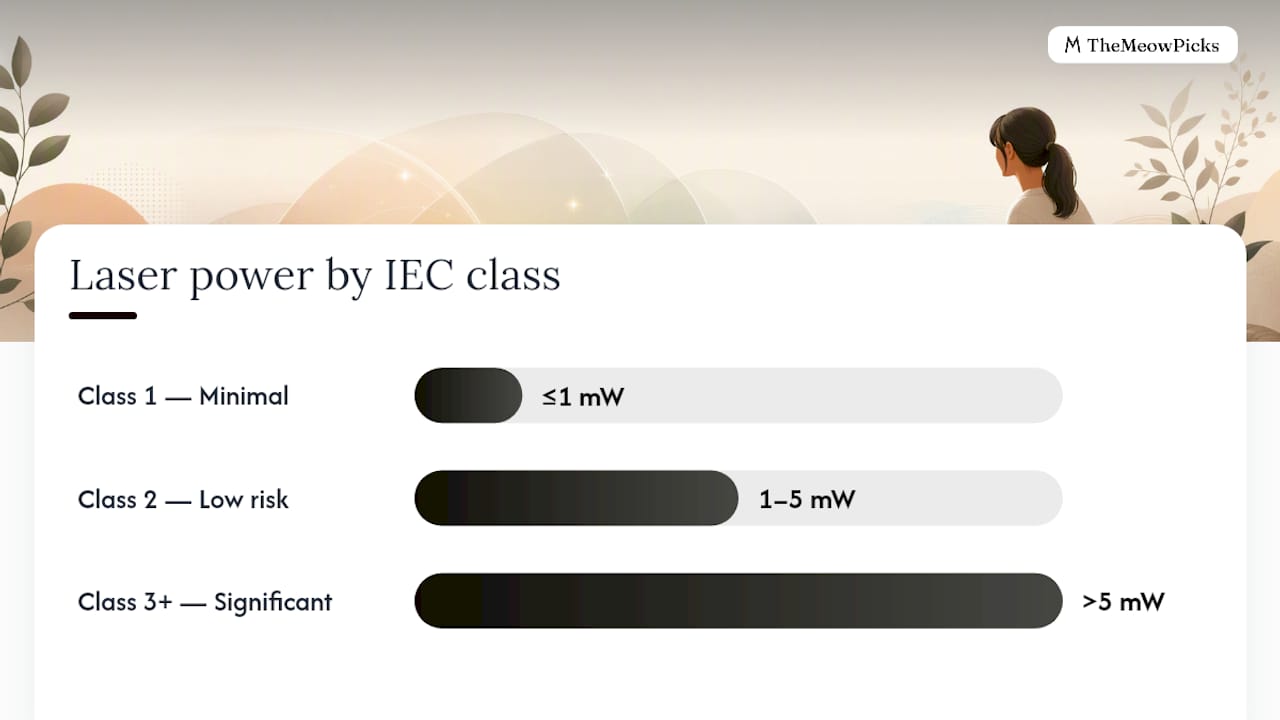
Not all laser toys carry the same risk, and the packaging gives you real information if you know what to look for. The FDA advises consumers to seek “Class 1 Laser Product” labeling and warns against toys that emit more than 5 mW or that lack any power labeling at all. A Federal Register draft guidance from the FDA similarly urged manufacturers to keep children’s toy lasers within IEC Class 1 emission limits to minimize risk.
Here is what those labels mean in plain terms:
| Power level | IEC class | Risk level | Typical product |
|---|---|---|---|
| ≤1 mW | Class 1 | Minimal under normal use | Safest consumer cat toys |
| 1–5 mW | Class 2 | Low but requires care; avoid direct eye contact | Many retail pointer toys |
| >5 mW | Class 3 or higher | Significant eye-injury risk | Not appropriate for pet use |
What to look for on the box:
- The words “Class 1 Laser Product” printed on the device or packaging.
- Power output listed in milliwatts (mW). If it is not printed, that is a red flag.
- A warning label about not aiming at eyes.
- A country-of-origin and manufacturer contact, which signals accountability.
If a product has no power labeling at all, skip it. The FDA’s guidance is clear: unlabeled laser toys should be avoided. You can report unsafe laser products to the FDA’s MedWatch program. Device features that add a layer of safety include auto-off timers (which prevent unsupervised sessions from running long), a broader dot pattern rather than a tight pinpoint beam, and remote-mounted units that keep the beam path away from hand-eye alignment.
Alternatives to laser-only play, and how to combine them
A laser toy works best as a teaser, not a complete play session on its own. Physical toys that let your cat stalk, catch, bite, and kick satisfy the full hunting sequence in a way a laser never can.
Physical alternatives worth keeping on hand:
- Wand toys with feathers or fabric tails (mimic bird prey)
- Motorized toys like the Jumpy Cat Jumping Toy (unpredictable movement without beam risk)
- Crinkle balls and small plush mice (for solo batting and carrying)
- Puzzle feeders (mental stimulation tied to food reward)
Three combination-play patterns that work:
A. Laser-to-toy handoff. Run the laser for 3–5 minutes, then slow the dot toward a wand toy lying on the floor. The moment the cat’s attention shifts to the wand, pick it up and let them catch it. This is the cleanest way to complete the hunting sequence.
B. Laser-then-treat sequence. End the laser session by landing the dot near a treat puzzle or a small pile of kibble. The cat “catches” food, which is a satisfying, tangible reward. International Cat Care recommends exactly this kind of sequence to prevent frustration.
C. Wand-on-cord follow-up. After a short laser burst, switch immediately to a wand toy and drag it along the floor. The transition keeps the energy going while giving the cat something real to grab.
For more ideas on keeping an indoor cat engaged, The Meow Picks has a full guide on indoor enrichment worth reading alongside this one.
When should you stop laser play and call a vet?
Some signs require you to stop immediately and seek professional help. Do not wait to see if they resolve on their own.
Eye-injury red flags (call your vet the same day):
- Squinting or holding one eye closed after a session
- Pawing repeatedly at the face or eyes
- Sudden clumsiness or apparent vision loss
- Persistent discharge or cloudiness in the eye
The American Academy of Ophthalmology emphasizes that retinal damage may be painless and delayed, so your cat may appear normal at first. Treat any possible eye exposure seriously, even if nothing looks wrong immediately.
Behavioral red flags (schedule a vet or behaviorist visit):
- Chasing shadows, reflections, or light spots obsessively outside of play sessions
- Redirected aggression: swatting or biting you or other pets after play
- Repetitive pacing or circling that does not settle
- Reduced appetite or withdrawal after laser sessions
When you call the vet, bring: the approximate date and duration of the exposure, the device’s power label (or a photo of the packaging), and a short video of the behavior if you can capture one. That information helps the vet triage quickly.
Common myths about laser toys that are worth correcting
Myth: “Red lasers are always safe.” Color has nothing to do with safety. A red laser at 50 mW is far more dangerous than a green one at 1 mW. Power output, not wavelength color, determines risk.
Myth: “If my cat seems fine, the laser didn’t hurt their eyes.” Retinal damage can be painless and may not produce visible symptoms for hours or days. The American Academy of Ophthalmology documents cases where patients felt no pain at the time of exposure. Assume any direct eye contact is a concern worth reporting to your vet.
Myth: “Lasers are a complete toy.” A laser is a teaser. It starts the hunt but cannot finish it. Cats that rely on laser play as their primary enrichment often develop the frustration behaviors described above. Variety and tactile rewards are not optional extras.
The FDA and veterinary checklist for safe laser use
This checklist pulls together the regulatory and veterinary guidance that underpins everything above.
FDA and IEC product standards:
- Look for “Class 1 Laser Product” printed on the device.
- Avoid any laser toy that emits more than 5 mW.
- Do not buy products with no power rating printed on the label.
- Report unlabeled or suspected high-power toys to the FDA’s MedWatch program.
Veterinary behavior guidance:
- Supervise every session; never leave an automated laser running alone.
- End every session with a physical toy or treat so the cat can complete the hunt.
- Use the laser as a teaser, not a primary toy.
- Clear the play area of hazards and reflective surfaces before you start.
- Monitor your individual cat’s response; some cats are more prone to frustration than others.
Authoritative sources to bookmark: the FDA’s consumer laser guidance, the American Academy of Ophthalmology for eye-injury risk, International Cat Care for behavior and hunting-sequence advice, and PetMD for practical owner guidance.
Our take on lasers as part of a cat’s play life
Laser toys get a bad reputation that is partly deserved and partly overblown. The real problem is almost never the device. It is the habit of clicking the laser on, letting the cat chase for twenty minutes, then putting it away without any resolution. That pattern, repeated often enough, is what produces anxious, obsessive cats.
Used as a short teaser before a wand-toy session or a treat puzzle, a well-labeled laser toy is a genuinely useful piece of a cat’s enrichment routine. At The Meow Picks, we look for toys that carry clear power labeling, auto-off features, and are built by makers who take product safety seriously. We also believe that the furniture and spaces around your cat matter as much as the toys themselves. A clear, soft-landing play zone makes every session safer, and a cozy retreat afterward helps your cat decompress. That is the philosophy behind everything we curate, and a portion of every order goes toward cat rescue, because the cats who need safe homes most are the ones who deserve our attention first.
Safe play spaces and tactile toys from The Meow Picks
The safest laser sessions happen in a clear, cat-friendly space where your cat can sprint, land softly, and retreat comfortably when play winds down. The Apawtment Cat House gives your cat a secure base to return to between bursts of activity, while the Torre Cat Tower provides stable vertical space with soft landing platforms that reduce the risk of dangerous jumps during active play. For a cozy post-session retreat, the Perla Cat Cave is a calm, enclosed space where your cat can decompress after the hunt.
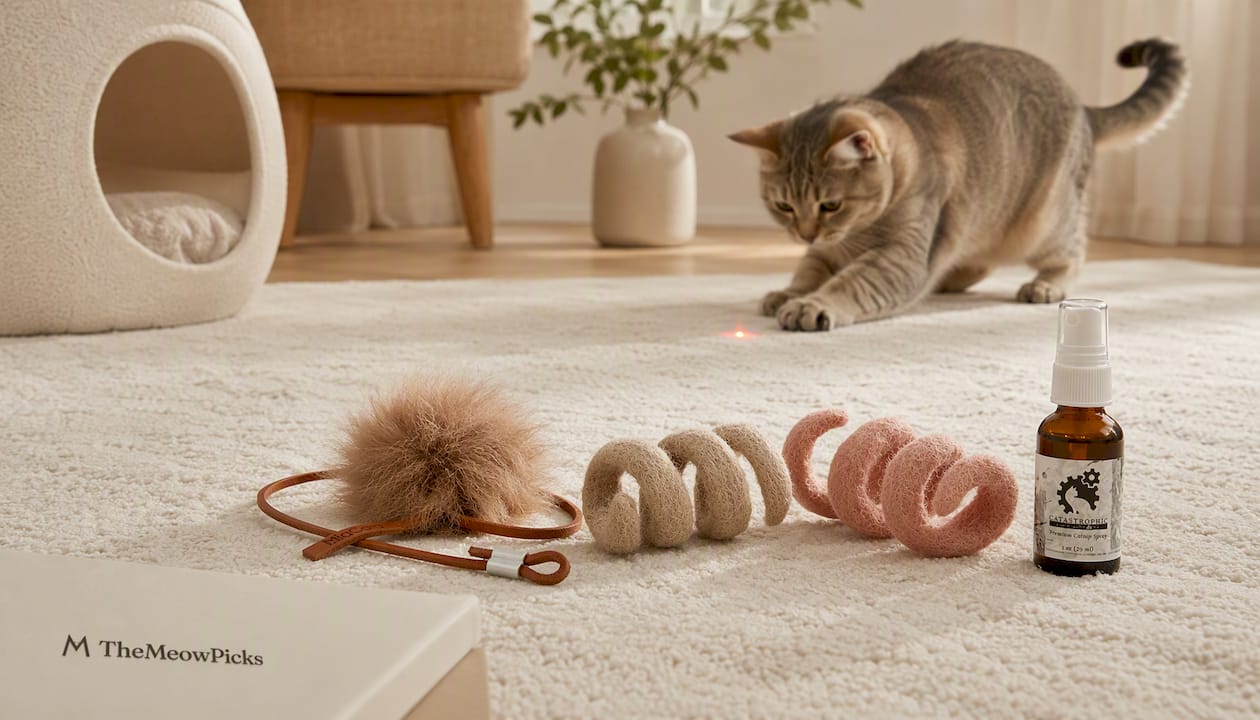
Every piece in The Meow Picks collection is chosen for design quality and thoughtful construction from independent makers worldwide. Pair any of these with a tactile toy for the end of your laser sessions, and you have a complete, safe play setup. Browse the full collection and find the right fit for your cat’s space and temperament.
Note: all play rules in this article apply regardless of which toys or furniture you use. Supervision and session structure are always the owner’s responsibility.
Sources
These are the primary sources behind the guidance in this article, each chosen for regulatory authority, clinical expertise, or veterinary credibility.
- Are Laser Pointers Bad for Cats? | PetMD
- Laser Toys: How to Keep Kids Safe | FDA
- Laser Pointers Are Still Not Toys - American Academy of Ophthalmology
- Are Laser Pointers Safe for Cats? | Hill’s Pet
- Playing with your cat | International Cat Care
This article is general information, not a substitute for advice from a qualified doctor. Consult a qualified healthcare professional about your own circumstances before acting on anything here.